- It Comes Down to One Question — Does the Drug Get In?
- Injectable Compounded Semaglutide — the Proven Route
- Sublingual Compounded Semaglutide — the Appeal and the Problem
- If Needles Are Your Real Objection
- Frequently Asked Questions
- Does sublingual semaglutide actually work?
- Is sublingual semaglutide the same as a Rybelsus pill?
- Why is injectable semaglutide considered more reliable?
- Is needle-free semaglutide a bad idea?
- Can sublingual semaglutide drops be dosed accurately?
- The Bottom Line
Affiliate disclosure: This article contains affiliate links. We may earn commission when you purchase through partner links, at no extra cost to you. Editorial independence preserved — recommendations based on provider compliance and patient outcomes, not commission rates. This article is informational and is not medical advice.
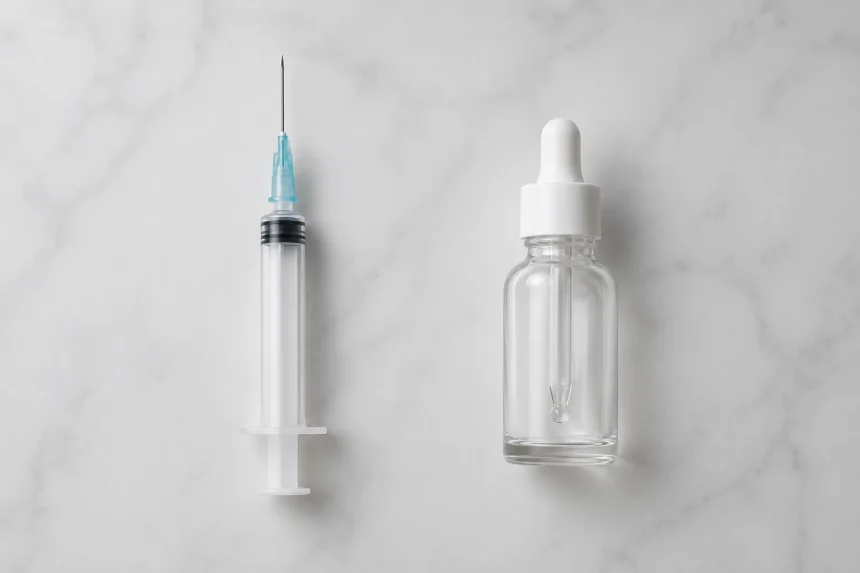
Compounded semaglutide is sold in two forms: an injection drawn from a vial, and a sublingual liquid placed under the tongue. The decision between them is almost always framed around the needle — whether you are willing to inject yourself or would rather not. That framing is understandable, but it skips the question that actually matters. Semaglutide only works if it reaches your bloodstream in a meaningful, consistent amount, and on that measure the injectable and sublingual forms are not equivalent. This guide explains why the route of delivery is the real decision, and what the evidence does — and does not — support.
It Comes Down to One Question — Does the Drug Get In?
Semaglutide is a large peptide molecule. That single fact drives everything about how it can be delivered, because large peptides are fragile and poorly absorbed: the digestive tract breaks them down, and they do not easily cross the body’s barriers into the blood. How much of a dose actually becomes active — its bioavailability — depends almost entirely on the route it takes.
This is not a technicality. It is the reason semaglutide was first developed as an injection, and the reason the oral version that followed required years of formulation work to function at all. When you compare injectable and sublingual compounded semaglutide, you are really comparing two answers to one question: how much of the drug gets in. Convenience matters — but it is the second question, not the first.
Injectable Compounded Semaglutide — the Proven Route
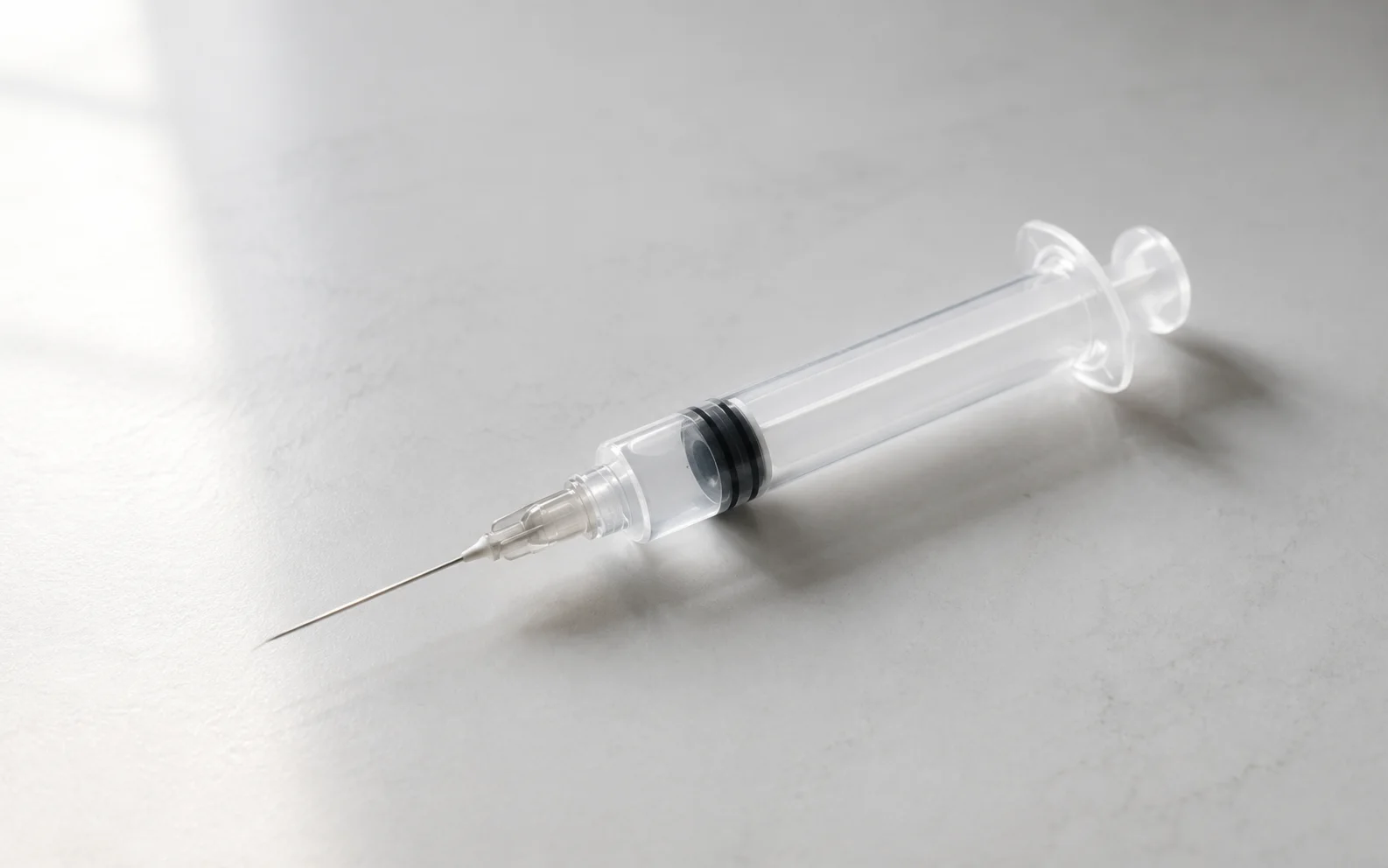
Injectable semaglutide is given as a subcutaneous injection — into the fat layer just under the skin — exactly the route used by Ozempic and Wegovy. From there it is absorbed slowly and steadily into the bloodstream, and its bioavailability is high: studies place subcutaneous semaglutide absorption at roughly 89% in humans. The dose you administer is, very nearly, the dose that reaches your system.
That reliability is the central advantage of the injectable form. It is the same delivery route as the FDA-approved products, with the same well-characterized pharmacology behind it. What is being compounded is the preparation and the packaging — not the way the drug enters the body.
The injectable form is not without its own issues, and they are real: it requires an injection, and — as covered in our guide to compounded semaglutide side effects — the vial-and-syringe format introduces dosing-error risks that an approved pen does not have. But those are problems of technique and packaging. They are not questions about whether the drug works. With the injectable route, absorption is settled.
Sublingual Compounded Semaglutide — the Appeal and the Problem
Sublingual compounded semaglutide is a liquid — or sometimes a dissolvable tablet or troche — held under the tongue. The appeal is obvious and legitimate: no needles. For people with a genuine needle phobia, or who simply will not inject, that is a meaningful barrier removed.
The theory behind it is that the tissue under the tongue is thin and rich in blood vessels, so a drug placed there can pass directly into the bloodstream, bypassing the stomach acid and digestive enzymes that destroy peptides. For some medications, that works well.
The problem is that semaglutide is a poor candidate for it. Sublingual absorption is efficient for small molecules; semaglutide is a large peptide, and large peptides cross the sublingual lining poorly. And here the evidence gap is the real issue. There is no robust body of human clinical data showing that compounded sublingual semaglutide delivers a therapeutic dose. The supporting research that exists is preclinical — a 2025 proof-of-concept study in rats, whose own authors framed it as a basis for future human pharmacokinetic research, not as evidence of effectiveness in people. Compounding pharmacies that sell the sublingual form tend to describe it in carefully hedged terms: absorption is “often thought to” improve, the formulation “may” support it — language that signals the absence of proof rather than its presence.
The FDA-approved oral semaglutide pill underlines the difficulty. To make semaglutide absorb when taken by mouth at all, its manufacturer had to pair it with a dedicated absorption enhancer and use it under strict dosing conditions — and even then, only a very small fraction of each dose, on the order of one percent, reaches the bloodstream, which is why the tablets are formulated at far higher strengths to compensate. That is what it took to make oral semaglutide work in a rigorously tested product. A compounded sublingual drop has none of that engineering behind it, and none of the trials. You cannot see or feel how much is being absorbed, which means a sublingual dose that reassuringly “feels” like treatment may be delivering far less drug than intended — or little at all.
If Needles Are Your Real Objection
If the needle is the genuine obstacle — and for many people it honestly is — the answer is not to accept an unproven sublingual product. It is to use a needle-free option that actually has evidence behind it.
There are now FDA-approved oral semaglutide tablets. Rybelsus has been available for type 2 diabetes since 2019, and in January 2026 an oral form of Wegovy — semaglutide 25 mg tablets — launched specifically for weight management, the first oral GLP-1 approved for that use. In its OASIS 4 trial, oral semaglutide produced average weight loss in the range of roughly 14 to 17 percent. These are swallowed tablets, not sublingual drops, and they work because they carry the absorption-enhancer formulation and the higher dosing that compounded sublingual products lack — and because they have been tested. Oral Wegovy also launched at a self-pay price near $149 a month for the starting dose, which means the proven, needle-free option is not necessarily the more expensive one.
So the needle-free choice is not really sublingual compounded semaglutide versus an injection. It is sublingual compounded semaglutide versus an FDA-approved oral tablet. One is needle-free and proven; the other is needle-free and unproven. Framed that way, the decision looks different. Our complete guide to Rybelsus covers the oral route in detail.
💊 Looking for a Lower-Cost Compounded Option?
For cash-pay patients, compounded semaglutide is a lower-cost compounded option through a clinician-supervised telehealth model. Direct Meds offers Summer 2026 promotional pricing:
- Compounded Semaglutide: $147 first month ($150 OFF regular $297)
- Clinician-supervised dosing and titration support
- 503B compounding pharmacy network — patient-specific prescriptions
- LegitScript-certified telemedicine compliance
- USP <795> and USP <797> sterile compounding standards
- Available in 48 states (excludes MS and LA)
Compounded semaglutide contains semaglutide, but the compounded product itself is not an FDA-approved finished product and is not reviewed by the FDA for safety, effectiveness or quality. Whether it is appropriate for you is a decision for you and your clinician.
Frequently Asked Questions
Does sublingual semaglutide actually work?
There is no robust human evidence that it does. Semaglutide is a large peptide, and large peptides are poorly absorbed through the lining of the mouth. The research supporting sublingual delivery is preclinical — a proof-of-concept study in rats — and the pharmacies selling it use hedged language rather than data. A sublingual dose may deliver far less drug than intended.
Is sublingual semaglutide the same as a Rybelsus pill?
No. Rybelsus is an FDA-approved tablet that you swallow; it contains a dedicated absorption enhancer and has been through clinical trials. Compounded sublingual semaglutide is a liquid held under the tongue, with none of that formulation technology and no trials behind it. Both avoid needles, but only one has proven, measured absorption.
Why is injectable semaglutide considered more reliable?
Because the subcutaneous route is well established. Injected under the skin, semaglutide reaches the bloodstream at roughly 89% bioavailability — the dose you give is very close to the dose you get. It is the same route used by Ozempic and Wegovy. With the injectable form, how much drug is absorbed is simply not in question.
Is needle-free semaglutide a bad idea?
Not at all — needle-free is a reasonable goal. The mistake is choosing a needle-free option that lacks evidence. FDA-approved oral semaglutide tablets are needle-free and proven. Compounded sublingual drops are needle-free and unproven. If you want to avoid injections, pick the one with trial data behind it.
Can sublingual semaglutide drops be dosed accurately?
Measuring liquid drops introduces its own variability, much as drawing from a vial does — but the deeper problem is different. Even a precisely measured sublingual dose tells you nothing about how much actually crossed into your bloodstream. With an unpredictable absorption route, dosing “accuracy” at the mouth is not the same as a reliable dose in the body.
The Bottom Line
Compounded semaglutide comes as an injection and as a sublingual liquid, and the two are not interchangeable. The injectable form uses the subcutaneous route — the same one as Ozempic and Wegovy — with high, predictable absorption; its real drawbacks are the needle and the dosing-format risks of vials, not whether the drug works. The sublingual form removes the needle, which is a genuine benefit, but it runs into a genuine problem: semaglutide is a large peptide that the lining of the mouth absorbs poorly, and there is no solid human evidence that compounded sublingual drops deliver a reliable, therapeutic dose.
If you can manage an injection, the injectable form is the one with settled pharmacology behind it. If the needle is the real obstacle, the evidence-based answer is an FDA-approved oral tablet, not an unproven sublingual compound. The honest summary is simple: convenience is worth a lot, but only once the drug is actually getting in. Choose the route first, then the convenience.
Considering a Compounded Option?
For cash-pay patients pursuing semaglutide, Direct Meds offers compounded semaglutide through a clinician-supervised telehealth model, with Summer 2026 promotional pricing:
- $150 OFF first month compounded semaglutide injection ($147 vs regular $297)
- Licensed clinician reviews eligibility and oversees dosing and titration
- 503B compounding pharmacy network — patient-specific prescriptions
- LegitScript-certified telemedicine compliance
- USP <795> and USP <797> sterile compounding standards
- Telemed evaluation included (typically $99 value), 1-2 day FedEx/UPS shipping
- Available in 48 states (excludes MS and LA)
180,000+ patients have used Direct Meds; current Trustpilot rating 4.8. Compounded semaglutide contains semaglutide, but the compounded product itself is not an FDA-approved finished product and is not reviewed by the FDA for safety, effectiveness or quality. Whether it is appropriate for you is a decision for you and your clinician.
Affiliate disclosure: allcheminfo.com receives commission when readers start treatment through Direct Meds. Recommendation based on their 503B pharmacy partnership, LegitScript certification, and clinician-supervised model — not commission rate.
This article is general information, not medical advice. Clinical and regulatory details reflect the situation as of May 2026. Discuss any treatment and delivery method with a licensed clinician.