Affiliate disclosure: This article contains affiliate links, and allcheminfo.com may earn a commission if you use them, at no extra cost to you. This article is informational and is not medical advice — always follow the storage instructions on your medication’s label and from your provider.
- The Basic Storage Rules
- How Long Can It Stay Out of the Fridge?
- Flying With Your GLP-1
- Vacations, Road Trips, and Hot Cars
- What If It Got Too Warm — or Froze?
- Frequently Asked Questions
- Does my GLP-1 medication need to be refrigerated?
- What happens if my GLP-1 medication freezes?
- Can I fly with my GLP-1 medication?
- How do I keep my GLP-1 cold while traveling?
- How can I tell if my GLP-1 medication has gone bad?
- What should I do with my GLP-1 during a power outage?
- The Bottom Line
GLP-1 drugs are peptides — delicate, protein-based molecules — and they are more sensitive to temperature than most people realize. Store one wrong, and it can quietly lose potency without any obvious sign. That matters in a way that is easy to miss: a person injecting a pen that has been spoiled by heat may simply feel that the drug “is not working,” never suspecting storage as the cause. The good news is that GLP-1 storage and travel are both simple once you know the rules, and traveling with one of these medications — including flying — is entirely manageable with a little planning. This guide covers both: how to store your medication at home, and how to keep it safe on the move.
The Basic Storage Rules
Three rules cover the essentials of storing a GLP-1 medication at home.
First, refrigerate it. Before you start using a pen, it belongs in the refrigerator, at 36 to 46°F (2 to 8°C) — the normal fridge range. Keep it on a shelf or in the door, not pushed against the back wall, which can be cold enough to freeze things.
Second, never freeze it. This is the rule that matters most. Freezing permanently destroys these medications — the peptide structure is damaged and cannot be undone. A GLP-1 pen that has frozen, even once, even if it looks fine afterward, should not be used. This is also why you should never let a pen rest directly against an ice pack.
Third, protect it from light and keep it in its original carton. The carton shields the medication from light, which can also degrade it, and it keeps the labeling and expiry date with the pen.
One more habit is worth building: inspect the medication before each injection. Semaglutide and tirzepatide solutions should be clear and colorless. If what you see is cloudy, discolored, or has particles floating in it, do not use that pen — those are signs the medication may have been compromised.
How Long Can It Stay Out of the Fridge?
The refrigerator is for storage — but these medications do not have to live in the fridge every moment. Each one can spend a defined stretch of time at room temperature, which is what makes daily life and travel practical. The allowance differs by product, and the differences are worth knowing precisely.
| Medication | Room-temperature allowance | Temperature limit |
|---|---|---|
| Ozempic (semaglutide) | Up to 56 days, after first use | Below 86°F (30°C) |
| Wegovy (semaglutide) | Up to 28 days, before first use | Below 86°F (30°C) |
| Mounjaro (tirzepatide) | Up to 21 days | Below 86°F (30°C) |
| Zepbound (tirzepatide) | Up to 21 days | Below 86°F (30°C) |
A few points about that table. The room-temperature limit is 86°F (30°C) across the board — these are not allowances to sit in real heat. The time windows are a one-way clock: once a medication has been kept at room temperature, that time counts toward its limit, and putting it back in the fridge does not reset the count. And the windows genuinely differ — if you switch from, say, Ozempic to a tirzepatide product, your room-temperature margin drops from 56 days to 21, which is easy to forget. Compounded semaglutide has its own storage instructions, set by the compounding pharmacy — typically refrigerated, with a use-by date once it is prepared — and those instructions are the ones to follow.
Whatever your product, the safe habit is the same: keep it refrigerated when you can, treat the room-temperature window as a budget rather than a default, and always check your specific medication’s leaflet for its exact numbers.
Flying With Your GLP-1
Flying with a GLP-1 medication is allowed and routine — millions of people do it. A few rules make it smooth.
The single most important one: keep your medication in your carry-on bag, never in checked luggage. The cargo hold is not temperature-controlled the way the cabin is; it can get cold enough to freeze your medication or hot enough to spoil it, and checked bags also get lost. Your medication stays with you.
For airport security, GLP-1 medications and the needles or syringes that go with them are permitted in carry-on baggage. Medically necessary medication — and the gel or ice packs needed to keep it cool — are exempt from the usual limits on liquids and gels. The practical steps: keep the medication in its original, labeled packaging; declare it to the security officer and be ready to remove it from your bag for separate screening; and carry a copy of your prescription, or a short letter from your provider, which is not strictly required but makes any questions easier. The pens themselves pass safely through X-ray machines.
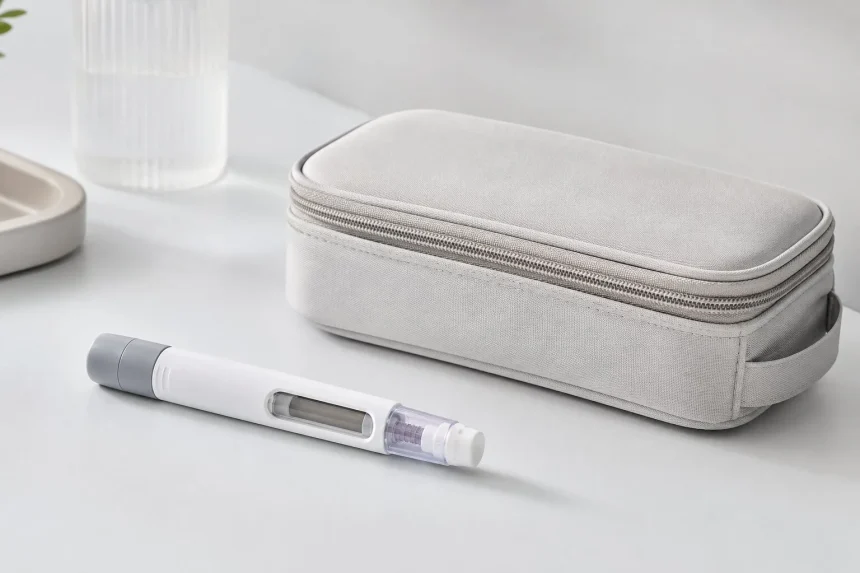
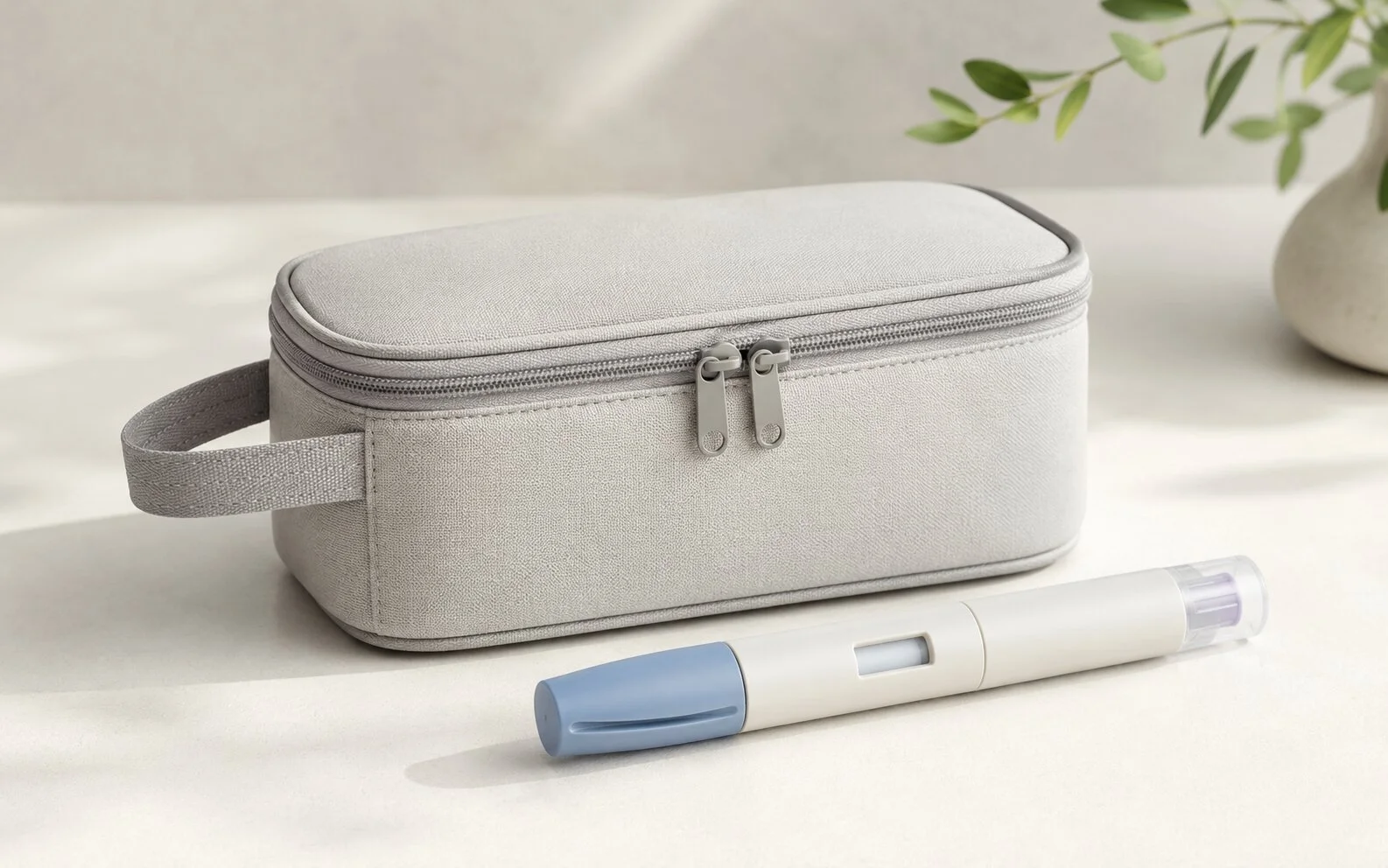
To keep the medication cool through the airport and the flight, use an insulated travel cooler or a medical-grade cooling case — the kind made for insulin works well. Use gel or ice packs, but wrap the medication so it does not sit directly against them and freeze. One realistic caveat: these travel coolers keep medication cool, but not always as cold as a true refrigerator, so they are best thought of as protecting your room-temperature window during transit rather than as a substitute for refrigeration.
💊 Looking for a Lower-Cost Compounded Option?
For cash-pay patients, compounded semaglutide is a lower-cost compounded option through a clinician-supervised telehealth model. Direct Meds offers Summer 2026 promotional pricing:
- Compounded Semaglutide: $147 first month ($150 OFF regular $297)
- Clinician-supervised dosing and titration support
- 503B compounding pharmacy network — patient-specific prescriptions
- LegitScript-certified telemedicine compliance
- USP <795> and USP <797> sterile compounding standards
- Available in 48 states (excludes MS and LA)
Compounded semaglutide contains semaglutide, but the compounded product itself is not an FDA-approved finished product and is not reviewed by the FDA for safety, effectiveness or quality. Whether it is appropriate for you is a decision for you and your clinician.
Vacations, Road Trips, and Hot Cars
Beyond the flight itself, a few more habits keep a GLP-1 medication safe while you travel.
The biggest ground-travel hazard is heat — and the worst offender is a parked car. A car interior in the sun can reach 120°F or more, far past the point that ruins these medications. Never leave a GLP-1 pen in a parked car, and keep it out of direct sun and away from a hot beach bag. On a road trip, the medication belongs in a cooler, not the glovebox.
When you reach your destination, refrigerate the medication as soon as you reasonably can — head to your accommodation and into the mini-fridge rather than detouring with the medication warming in a bag. If your accommodation has no reliable fridge, your medication’s room-temperature window will cover a limited stay, but plan around it.
Two more practical points. If you cross time zones, your weekly injection day still matters more than the exact hour — you can inject at any time of day, so simply pick a sensible time at your destination and keep the same day of the week, an approach also covered in our guide to the GLP-1 dosing schedule. And for international trips, check your destination country’s rules on bringing prescription medication before you go, and carry your prescription or provider’s letter. A small tip that prevents a lot of stress: travel with only the doses you need plus one spare, in case a return trip is delayed.
What If It Got Too Warm — or Froze?
Sometimes, despite planning, a medication’s storage gets compromised — a pen is left out overnight, a cooler fails, a fridge stops working. What then?
The clearest case is freezing. If a GLP-1 medication has frozen at any point, it should be discarded — freezing causes permanent damage, and no amount of thawing reverses it. This is not a judgment call.
Heat and time are more of a spectrum. If a pen has been left at room temperature but within its allowed window and below 86°F, it is generally fine — that is exactly what the window is for. If it has been exposed to real heat, or left out well beyond its room-temperature limit, it may no longer be reliable, and the safe course is to treat it as compromised. You usually cannot tell by looking — degraded medication often appears completely normal — so when a pen’s storage history is genuinely in doubt, the right move is to ask a pharmacist rather than guess.
A power outage deserves its own mention, since it worries people more than it usually should. A short outage is rarely a problem: a closed refrigerator holds its temperature for several hours, so the first step is simply to keep the door shut. And because your medication already has a room-temperature window measured in days, not hours, a brief outage comfortably fits inside it. The real concern is only a prolonged outage in a warm home that stretches past that window — in which case, move the medication to a cooler with ice packs, and if you are unsure afterward whether it stayed safe, ask a pharmacist.
This connects to a point worth holding on to. When a GLP-1 medication seems to have stopped working, people tend to think first of the drug, the dose, or their own body. Spoiled medication belongs on that list too — alongside other quiet culprits such as poor injection-site rotation. If results have slipped and the medication has had a rough storage history — a hot car, a long unrefrigerated stretch, a power outage — the problem may simply be a pen that is no longer fully potent. It is one more reason that good storage quietly protects your results.
Frequently Asked Questions
Does my GLP-1 medication need to be refrigerated?
Yes — before first use, GLP-1 pens should be kept in the refrigerator at 36-46°F (2-8°C). Once in use, each can spend a defined period at room temperature: up to 56 days for Ozempic, 28 for Wegovy, and 21 for Mounjaro and Zepbound, all below 86°F.
What happens if my GLP-1 medication freezes?
Freezing permanently destroys these medications — the peptide structure is damaged irreversibly. A pen that has frozen, even once, even if it looks normal afterward, should be discarded and not used.
Can I fly with my GLP-1 medication?
Yes. GLP-1 medications and their needles are allowed in carry-on baggage, and the medically necessary ice packs to keep them cool are exempt from liquid limits. Always pack the medication in your carry-on — never checked luggage — and keep it in original, labeled packaging.
How do I keep my GLP-1 cold while traveling?
Use an insulated travel cooler or a medical-grade cooling case with gel or ice packs, keeping the medication wrapped so it does not freeze against the packs. At your destination, refrigerate it as soon as possible, and never leave it in a hot car or in direct sun.
How can I tell if my GLP-1 medication has gone bad?
Often you cannot tell by looking — degraded medication can appear normal. Visible cloudiness, discoloration or particles are clear signs not to use it, and any pen that has frozen should be discarded. When a pen’s storage history is in doubt, ask a pharmacist.
What should I do with my GLP-1 during a power outage?
Keep the refrigerator door closed — a closed fridge holds its temperature for several hours, and your medication’s room-temperature window (days, not hours) covers a short outage comfortably. Only a prolonged outage in a warm home is a real concern; if that happens, move the medication to a cooler with ice packs, and ask a pharmacist if you are later unsure whether it stayed within safe limits.
The Bottom Line
GLP-1 drugs are temperature-sensitive peptides, and treating them that way protects both your investment and your results. The core rules are short: refrigerate before first use, never freeze, keep it out of the light, and respect the room-temperature window — 56 days for Ozempic, 28 for Wegovy, 21 for the tirzepatide products, all below 86°F. Traveling is entirely doable: carry it on, never check it; keep it cool in an insulated case; declare it at security; and keep it out of hot cars.
The thread running through all of it is that storage damage is invisible. A spoiled pen does not usually look spoiled — it just works less well, in a way that is easy to blame on the drug or the dose. Storing your medication properly, and not gambling with a pen whose history is in doubt, is one of the simplest ways to make sure the medication you inject is the medication you were prescribed.
Considering a Compounded Option?
For cash-pay patients pursuing semaglutide, Direct Meds offers compounded semaglutide through a clinician-supervised telehealth model, with Summer 2026 promotional pricing:
- $150 OFF first month compounded semaglutide injection ($147 vs regular $297)
- Licensed clinician reviews eligibility and oversees dosing and titration
- 503B compounding pharmacy network — patient-specific prescriptions
- LegitScript-certified telemedicine compliance
- USP <795> and USP <797> sterile compounding standards
- Telemed evaluation included (typically $99 value), 1-2 day FedEx/UPS shipping
- Available in 48 states (excludes MS and LA)
180,000+ patients have used Direct Meds; current Trustpilot rating 4.8. Compounded semaglutide contains semaglutide, but the compounded product itself is not an FDA-approved finished product and is not reviewed by the FDA for safety, effectiveness or quality. Whether it is appropriate for you is a decision for you and your clinician.
Affiliate disclosure: allcheminfo.com receives commission when readers start treatment through Direct Meds. Recommendation based on their 503B pharmacy partnership, LegitScript certification, and clinician-supervised model — not commission rate.
This article is general information, not medical advice. Storage figures reflect product labeling as of May 2026; always follow the specific storage instructions on your medication’s label and from your provider or pharmacist.