- Start Here — It’s the Same Drug as Ozempic and Wegovy
- What the Additives Change
- The Real Difference Is Dosing, Not the Drug
- Why Concentration Varies — and Why It Matters
- Salt Forms and the Consistency You Can’t See
- Frequently Asked Questions
- Does compounded semaglutide have different side effects than Ozempic?
- Is compounded semaglutide with B12 easier to tolerate?
- Why are people overdosing on compounded semaglutide?
- What should compounded semaglutide look like in the vial?
- What should I do about severe nausea or vomiting on compounded semaglutide?
- The Bottom Line
Affiliate disclosure: This article contains affiliate links. We may earn commission when you purchase through partner links, at no extra cost to you. Editorial independence preserved — recommendations based on provider compliance and patient outcomes, not commission rates. This article is informational and is not medical advice.
If you are weighing compounded semaglutide, here is the honest starting point: it is the same active drug as Ozempic and Wegovy. The molecule does not change when a pharmacy compounds it — which means the core side-effect profile does not change either. Compounded semaglutide is not gentler on your stomach, and it is not harsher. What genuinely differs with the compounded version is everything around the molecule: the additives mixed in with it, the vial-and-syringe format you dose yourself, the concentration that is not standardized between pharmacies, and a level of quality control that has not been through FDA review. Those differences are where the real, compounded-specific risks live. This guide focuses on injectable compounded semaglutide — the most common form — and walks through each one.
Start Here — It’s the Same Drug as Ozempic and Wegovy
Semaglutide is semaglutide. Whether it arrives in a Wegovy pen or a compounding pharmacy’s vial, it acts on the same GLP-1 receptors in the same way, and it produces the same well-documented side effects.
The common ones are gastrointestinal: nausea, vomiting, diarrhea and constipation, most pronounced in the early weeks and after each dose increase, and easing for many people as the body adjusts. The class also carries less common but more serious considerations — gallbladder problems, pancreatitis, and the labeled warnings that apply to semaglutide regardless of where it was made. None of that changes for a compounded preparation. For a full walkthrough of managing the GI effects, see our GLP-1 GI side effects survival guide.
This matters because of a common misconception. Compounding pharmacies sometimes market their formulations as smoother or better tolerated, often pointing to an added ingredient. The drug itself gives no reason to expect that. If a compounded version feels different from a brand pen, the explanation is almost always in the dose, the speed of titration, or the additives — not in some improved form of semaglutide.
What the Additives Change
The most common compounded formulation is semaglutide combined with vitamin B12, sometimes with glycine and occasionally other ingredients. These additives are the first genuine difference from a brand pen, which contains semaglutide and standard inactive excipients only.
The rationale offered for B12 is reasonable on its face: semaglutide slows digestion and reduces food intake, which can, over time, affect absorption of nutrients including B12, so some formulations add it as a buffer against deficiency. Glycine is usually present as a stabilizer for the peptide in solution — a formulation-chemistry role more than a therapeutic one. On their own, these additives are generally well tolerated; in large amounts glycine can cause mild GI upset and B12 can occasionally cause restlessness, but significant problems are uncommon.
Two honest caveats matter more than the additives’ own side effects. First, the claim that B12 makes semaglutide easier to tolerate — less nausea, more energy — rests on weak evidence; it is largely a marketing position, not a proven benefit. Do not choose a compounded formula expecting the added ingredient to blunt side effects. Second, B12 turns the solution pink or red, and that color can mask two warning signs: it makes it harder to see whether the semaglutide solution has become cloudy or discolored, and if B12 did dull nausea, it could obscure the body’s signal that a dose is too high. Neither is a reason to avoid B12 — but it is a reason not to treat the colored solution as a feature.

The Real Difference Is Dosing, Not the Drug
This is the single most important difference, and it is not about side effects from the medication — it is about side effects from taking the wrong amount of it.
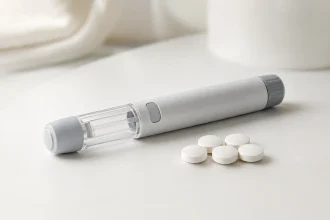
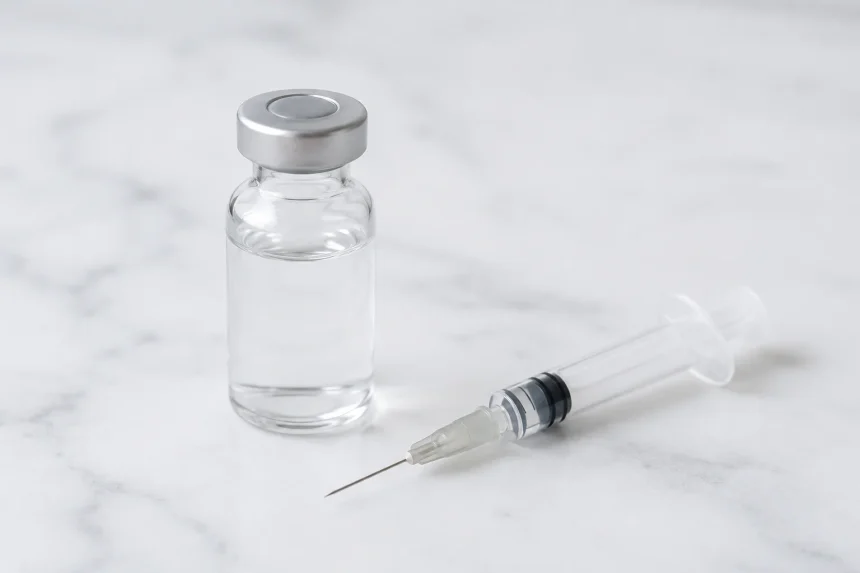
FDA-approved injectable semaglutide is delivered in a prefilled pen. The dose is preset, defined in milligrams, with a standardized concentration; you dial or click, you do not measure. Compounded semaglutide is most often supplied in a multidose vial, from which you draw each dose yourself into a syringe, measuring it by volume. Some compounders instead supply prefilled syringes, measured in advance — that removes the draw-it-yourself step, but it does not standardize the concentration, and the dose is still expressed in units that can be misread.
In July 2024 the FDA issued an alert after receiving reports of dosing errors and overdoses with compounded injectable semaglutide. Some patients had administered five to twenty times their intended dose. The agency pointed to two causes: inexperience with drawing medication from a vial into a syringe, and confusion between units of measurement — milligrams, milliliters and “units” are not the same thing, and a dose described in one can be misread in another. The consequences reported were serious: intense nausea and vomiting, abdominal pain, dehydration, fainting, severe low blood sugar, pancreatitis and gallstones, with some patients hospitalized. Because semaglutide has a long half-life of around a week, an overdose is not a brief problem.
So when people describe “compounded semaglutide side effects” that seem far worse than anything expected, the cause is often not a worse drug. It is a dosing error that the pen format would have prevented.
Why Concentration Varies — and Why It Matters
There is no standard concentration for compounded semaglutide. One pharmacy’s vial might be formulated so that a given volume delivers a particular dose; another pharmacy’s vial, at a different concentration, delivers a different dose for that same volume.
This has a practical consequence that catches people out. The number of “units” on your syringe is not a portable measure. If you switch compounding pharmacies, or your pharmacy changes its formulation, the same mark on the syringe can mean a different amount of drug. A dose you have taken safely for months can quietly become an under- or overdose because the concentration changed. This is why your dose should always be confirmed against the specific product you currently hold — and never assumed from a previous vial.

Salt Forms and the Consistency You Can’t See
Two final differences are about what you cannot verify just by looking.
The first is the form of the active ingredient. Approved semaglutide uses the semaglutide base. Some compounders, particularly during the shortage period, used salt forms — semaglutide sodium or semaglutide acetate — which the FDA has flagged as chemically different from the approved base and not reviewed by the agency. Whether a salt form behaves identically, including in its side effects, is not established. A legitimate pharmacy can tell you which form it dispenses.
The second is consistency itself. An FDA-approved pen is one output of an extensively reviewed manufacturing process: every pen, every dose, made to the same specification. A compounded preparation has not been through that review. Vial-to-vial consistency, the accuracy of the stated concentration, and sterility all rest on the individual pharmacy’s standards rather than on FDA oversight. A well-run, accredited pharmacy can do this well — but the assurance comes from the pharmacy, not from the system, which is exactly why verifying the pharmacy matters. Our guide on how to verify a compounding pharmacy covers how to do that.
💊 Looking for a Lower-Cost Compounded Option?
For cash-pay patients, compounded semaglutide is a lower-cost compounded option through a clinician-supervised telehealth model. Direct Meds offers Summer 2026 promotional pricing:
- Compounded Semaglutide: $147 first month ($150 OFF regular $297)
- Clinician-supervised dosing and titration support
- 503B compounding pharmacy network — patient-specific prescriptions
- LegitScript-certified telemedicine compliance
- USP <795> and USP <797> sterile compounding standards
- Available in 48 states (excludes MS and LA)
Compounded semaglutide contains semaglutide, but the compounded product itself is not an FDA-approved finished product and is not reviewed by the FDA for safety, effectiveness or quality. Whether it is appropriate for you is a decision for you and your clinician.
Frequently Asked Questions
Does compounded semaglutide have different side effects than Ozempic?
The core side effects are the same, because it is the same active drug — nausea, vomiting, diarrhea and constipation are common with both, and the class risks apply to both. The real differences are not pharmacological: they come from the additives mixed in, the vial-and-syringe dosing, and concentrations that vary between pharmacies. The molecule behaves the same; the packaging around it does not.
Is compounded semaglutide with B12 easier to tolerate?
Probably not in the way it is marketed. B12 is added mainly to guard against deficiency from reduced food intake, and the claim that it reduces nausea or boosts energy rests on weak evidence. Do not choose a B12 formulation expecting gentler side effects. The B12 also tints the solution red, which can make it harder to spot if the semaglutide has gone cloudy or discolored.
Why are people overdosing on compounded semaglutide?
Because it is drawn from a vial by hand rather than delivered by a fixed-dose pen. The FDA’s July 2024 alert described patients taking five to twenty times their intended dose, driven by unfamiliarity with vial-and-syringe injection and confusion between milligrams, milliliters and “units.” The overdose symptoms — severe nausea, vomiting, dehydration, fainting — are intense and, given semaglutide’s long half-life, prolonged.
What should compounded semaglutide look like in the vial?
Plain compounded semaglutide solution should be clear and colorless; formulations with B12 will be pink or red. In either case, cloudiness, visible particles, or a change in appearance from previous vials is a reason not to use it and to contact the pharmacy. Be aware that the B12 color can mask early signs of an unstable solution, so inspect each vial carefully.
What should I do about severe nausea or vomiting on compounded semaglutide?
Some nausea is expected early in treatment and after dose increases. But severe vomiting, abdominal pain, dehydration or fainting are not symptoms to push through — they can signal too high a dose or a dosing error. Contact your provider, do not take more medication to “catch up,” and never adjust your dose on your own. With compounded vials, a measuring mistake is a real possibility worth ruling out.
The Bottom Line
Compounded semaglutide is the same drug as Ozempic and Wegovy, so its core side effects — the GI effects, the class risks — are the same. The differences that matter are not in the molecule. They are in the additives, whose tolerability benefits are oversold and whose color can hide warning signs; in the vial-and-syringe format that makes dosing errors genuinely possible; in concentrations that vary between pharmacies; and in a consistency that rests on the pharmacy rather than on FDA review.
None of this means compounded semaglutide cannot be used safely — large numbers of people do. It means the added risk is specific and manageable: use a pharmacy you have verified, insist on the correctly sized syringe and clear written dosing instructions, confirm your concentration every time you receive a new vial, never adjust your own dose, look at the solution before you use it, and treat severe symptoms as a reason to call your provider rather than push through. The drug is not the variable. Everything around it is.
Considering a Compounded Option?
For cash-pay patients pursuing semaglutide, Direct Meds offers compounded semaglutide through a clinician-supervised telehealth model, with Summer 2026 promotional pricing:
- $150 OFF first month compounded semaglutide injection ($147 vs regular $297)
- Licensed clinician reviews eligibility and oversees dosing and titration
- 503B compounding pharmacy network — patient-specific prescriptions
- LegitScript-certified telemedicine compliance
- USP <795> and USP <797> sterile compounding standards
- Telemed evaluation included (typically $99 value), 1-2 day FedEx/UPS shipping
- Available in 48 states (excludes MS and LA)
180,000+ patients have used Direct Meds; current Trustpilot rating 4.8. Compounded semaglutide contains semaglutide, but the compounded product itself is not an FDA-approved finished product and is not reviewed by the FDA for safety, effectiveness or quality. Whether it is appropriate for you is a decision for you and your clinician.
Affiliate disclosure: allcheminfo.com receives commission when readers start treatment through Direct Meds. Recommendation based on their 503B pharmacy partnership, LegitScript certification, and clinician-supervised model — not commission rate.
This article is general information, not medical advice. Side-effect and regulatory details reflect the situation as of May 2026. Discuss any treatment, dose change or troubling symptom with a licensed clinician.