- Before You Start: Where and When to Inject
- Injecting With a Prefilled Pen
- Injecting With a Vial and Syringe
- Comfort Tips and Common Mistakes
- Disposing of Needles Safely
- Frequently Asked Questions
- Where is the best place to inject semaglutide?
- Does injecting semaglutide hurt?
- How do I know how much compounded semaglutide to inject?
- What time of day should I inject semaglutide?
- Do I need to pinch my skin when injecting?
- Does compounded semaglutide need to be mixed before use?
- The Bottom Line
Affiliate disclosure: This article contains affiliate links, and allcheminfo.com may earn a commission if you use them, at no extra cost to you. This article is informational and is not medical advice — always follow the specific instructions from your provider and your medication’s leaflet.
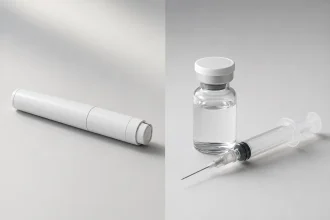
Giving yourself an injection can feel intimidating the first time — but for the vast majority of people, it quickly becomes a simple, almost unremarkable weekly routine. Semaglutide is a subcutaneous injection, meaning it goes into the layer of fat just under the skin, and it comes in two main forms: a prefilled pen, used for brand-name products like Ozempic and Wegovy, and a vial that you draw from with a syringe, which is how compounded semaglutide is usually supplied. This guide walks through how to inject semaglutide with both — along with how to make it comfortable, the mistakes to avoid, and how to dispose of needles safely. One thing it is not: a substitute for the specific instructions your provider and your medication’s leaflet give you. Where those differ from anything here, follow them.
Before You Start: Where and When to Inject
Two things are worth settling before the first injection: where on your body the injection goes, and when.
Semaglutide is injected subcutaneously — into the fat layer just beneath the skin, not into muscle and not into a vein. There are three standard injection sites: the abdomen (the stomach, staying at least a couple of inches away from the navel), the front of the thigh (avoiding the inner thigh), and the back of the upper arm, between the shoulder and elbow. The abdomen is the most popular because it is easy to see and reach. The upper arm is harder to do on yourself, so many people who use that site ask someone to help.
Rotating the site matters. Injecting into the same spot week after week can cause lumps of hardened tissue to build up under the skin, which is uncomfortable and can interfere with how the medication is absorbed. The simple fix is to use a different spot each week — and even within one site, to move to a fresh patch of skin each time. It is also worth avoiding any skin that is bruised, tender, scarred, lumpy, red, or broken — pick a healthy area for each injection.
Timing is more flexible than people expect. Semaglutide is injected once a week, and the goal is consistency: pick a day of the week and stick to it. It can be taken at any time of day, with or without food. Your prescribed dose itself usually starts low and steps up gradually over months, as our GLP-1 dosing guide explains. If you ever need to change your injection day, there are rules about how to do it safely — your medication’s instructions cover that.
Injecting With a Prefilled Pen
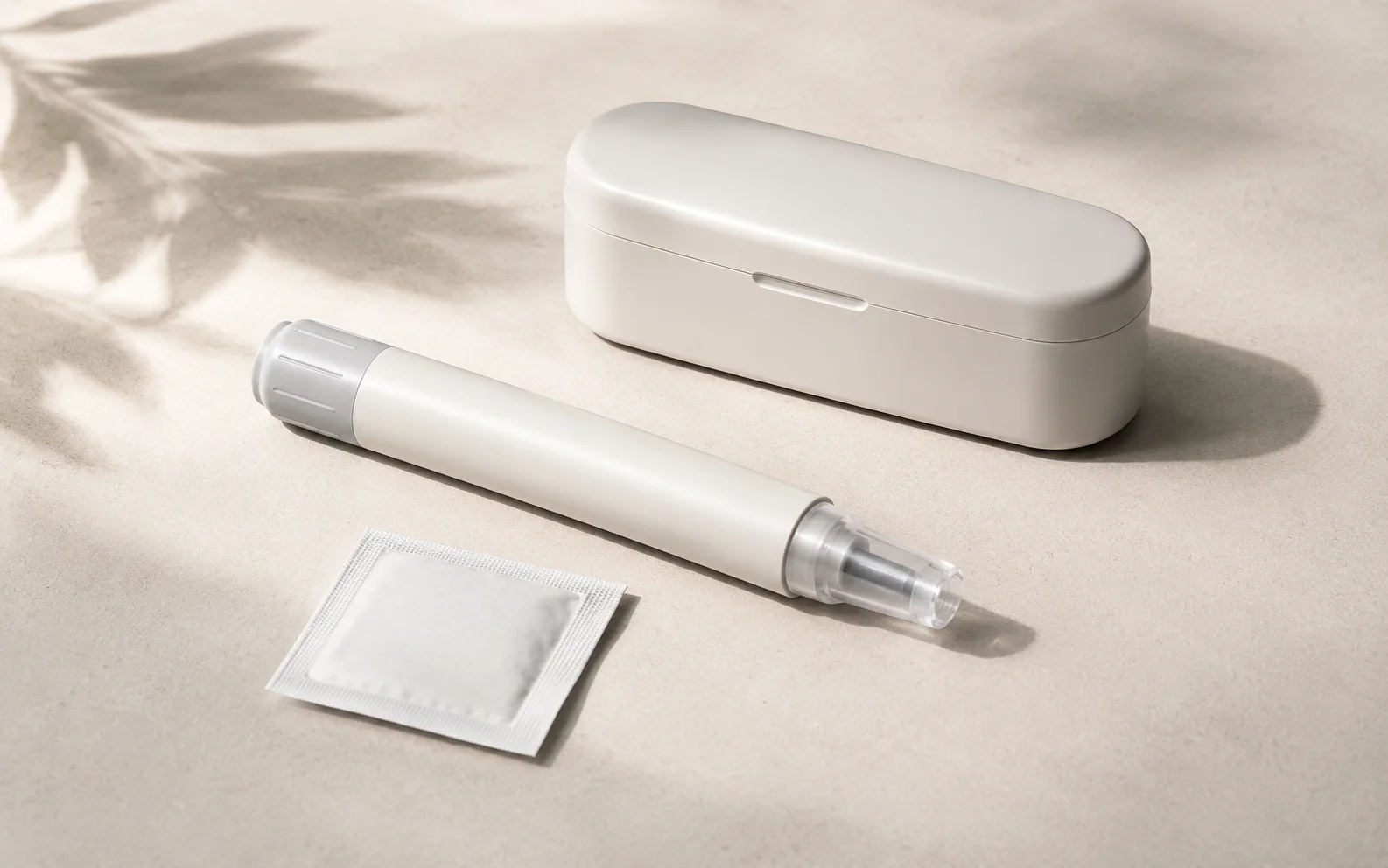
Brand-name semaglutide — Ozempic and Wegovy — comes in a prefilled pen. The exact mechanics vary slightly between products, so the pen’s own instruction leaflet is the final word, but the general process is the same.
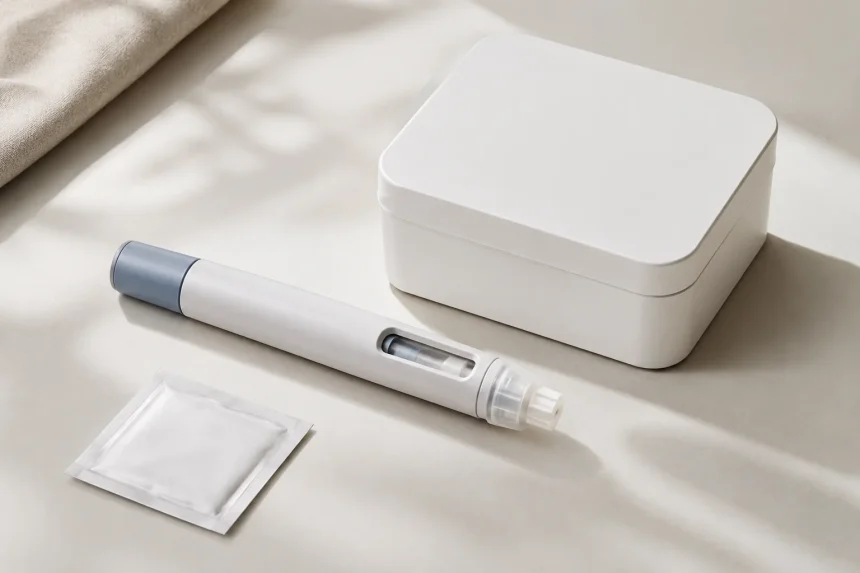
You will need the pen, a new needle, an alcohol swab, and a sharps container for disposal.
- Wash your hands thoroughly with soap and water.
- Check the medication through the pen’s window — it should be clear and colorless. Do not use it if it looks cloudy or discolored, or has particles in it.
- Attach a new needle to the pen, following the leaflet’s instructions. With a brand-new pen, you may need to do a flow check to clear air and confirm it is working — the leaflet explains how.
- Set the dose. Dial the pen to your prescribed dose, and double-check that the dose counter shows the right number.
- Choose your site and clean it with an alcohol swab, wiping in a circle from the center outward. Let the skin air-dry.
- Insert the needle straight into the skin at a 90-degree angle.
- Press and hold the dose button until the counter returns to zero (Ozempic) or the dose indicator stops moving (Wegovy).
- Keep the needle in place after the dose finishes — count slowly, around six seconds for Ozempic and up to ten for Wegovy — then withdraw it. This makes sure the full dose is delivered and does not leak back out.
- Remove the needle and place it straight into your sharps container.
The whole process takes a minute or two once you are used to it.
Injecting With a Vial and Syringe
Compounded semaglutide is supplied as a vial — but in one of two forms, and it is important to know which you have. Some arrives as a ready-to-inject liquid solution, with the concentration printed on the label. Others arrive as a freeze-dried powder, packaged with a separate vial of bacteriostatic water, which must be mixed — reconstituted — before the first dose.
If yours is a powder, do not inject it as is and do not improvise the mixing: your compounding pharmacy provides specific reconstitution instructions, including the exact amount of bacteriostatic water to add, and those must be followed precisely — and the bacteriostatic water provided is what to use, not plain sterile water or saline. The steps below describe injecting from a vial of liquid, whether it arrived that way or you have reconstituted it according to your pharmacy’s directions. Drawing from a vial involves a few more steps than a pen, and one of them deserves special attention.
You will need the vial, a new sterile syringe with a needle, alcohol swabs, a sharps container, and a clean surface to work on. If you are sourcing compounded semaglutide, it is also worth being sure of the pharmacy behind it — our guide on how to verify a compounding pharmacy covers that.
Before anything else, the dose. Compounded semaglutide syringes are marked in units, not in milligrams — and your prescribed dose will have been translated into a specific number of units by your provider. This is the single most important number in the process. Measure it exactly. If you are not certain how many units your dose is, do not guess and do not proceed — contact your provider and confirm first.
- Wash your hands thoroughly with soap and water, and dry them.
- Check the medication — it should be clear and colorless, with no particles, and within its expiry date.
- Clean the rubber top of the vial with an alcohol swab and let it dry.
- Take the caps off the syringe and needle, being careful not to touch the needle itself.
- Pull the plunger back to draw in a volume of air equal to your dose. Push the needle through the rubber top of the vial and press that air into the vial — this equalizes the pressure and makes the liquid easier to draw.
- Turn the vial upside down with the needle still in it, and slowly pull the plunger back to draw up your prescribed dose in units.
- Check for air bubbles. Tap the syringe so any bubbles rise to the top, then gently push them back into the vial. Re-check that you still have the correct dose, drawing up a little more if needed.
- Choose and clean your injection site with an alcohol swab, and let it air-dry.
- Pinch a fold of skin at the site. Insert the needle all the way in at a 90-degree angle — or at 45 degrees if you are injecting into a thinner area with little fat.
- Push the plunger down slowly and steadily until all the medication is delivered.
- Pause for a few seconds, then release the pinch and withdraw the needle.
- Place the used syringe and needle straight into your sharps container.
As with the pen, this becomes quick and routine with practice.
💊 Looking for a Lower-Cost Compounded Option?
For cash-pay patients, compounded semaglutide is a lower-cost compounded option through a clinician-supervised telehealth model. Direct Meds offers Summer 2026 promotional pricing:
- Compounded Semaglutide: $147 first month ($150 OFF regular $297)
- Clinician-supervised dosing and titration support
- 503B compounding pharmacy network — patient-specific prescriptions
- LegitScript-certified telemedicine compliance
- USP <795> and USP <797> sterile compounding standards
- Available in 48 states (excludes MS and LA)
Compounded semaglutide contains semaglutide, but the compounded product itself is not an FDA-approved finished product and is not reviewed by the FDA for safety, effectiveness or quality. Whether it is appropriate for you is a decision for you and your clinician.
Comfort Tips and Common Mistakes
Done correctly, a semaglutide injection is generally close to painless. A few habits make it more comfortable and more reliable.
The biggest comfort difference is temperature. Injecting cold medication straight from the fridge stings more than it needs to. Taking the pen or vial out around half an hour before injecting, so it reaches room temperature — or gently rolling a vial between your palms — makes the injection noticeably more comfortable. Beyond that: always use a fresh needle, inject into bare skin rather than through clothing, insert the needle quickly and smoothly rather than slowly, and try to keep the area relaxed rather than tensed. Afterward, a small drop of blood or a little bruising at the site is normal — press gently with a clean cotton ball or gauze rather than rubbing.
A handful of mistakes are common enough to call out specifically:
- Reusing needles. A reused needle is duller, which hurts more and raises infection risk, and can deliver less than the full dose. Use a new one every time.
- Not rotating sites. Injecting the same spot repeatedly causes hard lumps and patchy absorption. Move around.
- Withdrawing the needle too fast. Pulling out before the dose has fully settled can let medication leak back out, shorting your dose. Pause first.
- Injecting through clothing. This is not sterile, and you cannot see what you are doing. Always expose the skin.
- Injecting into muscle. A shallow angle on a lean area, or aiming wrong, can hit muscle, which is more painful and changes absorption. Subcutaneous fat is the target.
None of these is catastrophic on its own, but avoiding them keeps the routine comfortable and your dosing accurate.
Disposing of Needles Safely
Used needles and syringes are classified as medical sharps, and they need to go into a proper sharps container — a rigid, puncture-resistant container made for the purpose. Pen needles, syringes and used pens all go in it.
Two rules matter most. Never recap a needle by hand — that is when accidental needle-stick injuries most often happen. And never put loose needles in your household trash, where they can injure waste workers or family members. Keep the sharps container out of the reach of children and pets, and when it is about three-quarters full, dispose of it according to your local guidance — many areas have pharmacy take-back programs or specific collection rules. If you do not have a purpose-made sharps container yet, a heavy-duty, puncture-proof plastic container with a tight lid can serve in the meantime, though a real sharps container is better.
Frequently Asked Questions
Where is the best place to inject semaglutide?
The three standard sites are the abdomen, the front of the thigh, and the back of the upper arm. The abdomen is the easiest to see and reach. Whichever you use, rotate to a fresh spot each week to avoid hard lumps and absorption problems.
Does injecting semaglutide hurt?
Usually very little. The needles are short and fine, and done correctly the injection is close to painless. Letting the medication reach room temperature first, using a fresh needle, and inserting it quickly all reduce any discomfort.
How do I know how much compounded semaglutide to inject?
Your provider translates your prescribed dose into a specific number of units on the syringe — compounded syringes are marked in units, not milligrams. Measure exactly the number of units your provider specified, and if you are unsure, confirm with them before injecting rather than guessing.
What time of day should I inject semaglutide?
Any time — semaglutide is a once-weekly injection that can be given at any time of day, with or without food. What matters is consistency: pick a day of the week and a routine you will reliably keep.
Do I need to pinch my skin when injecting?
Pinching a fold of skin lifts the fat away from the muscle and gives a stable surface, which can help — especially with a syringe or on leaner areas. With some pens it is optional. Follow your medication’s instructions; either way, the target is the fat layer just under the skin.
Does compounded semaglutide need to be mixed before use?
It depends on the form. Some compounded semaglutide arrives as a ready-to-use liquid and needs no mixing. Other vials arrive as a freeze-dried powder that must be reconstituted with bacteriostatic water before the first dose. If yours is a powder, follow the specific reconstitution instructions from your compounding pharmacy exactly — do not improvise the amounts or substitute plain sterile water for the bacteriostatic water provided.
The Bottom Line
Injecting semaglutide is a genuinely simple skill, and one that almost everyone gets comfortable with quickly. The essentials are the same whichever form you use: it goes into the fat just under the skin, at one of three sites, rotated each week; the medication should be clear and at room temperature; the dose must be exactly right — especially with a vial, where it is measured in units; and the needle goes into a sharps container, never the trash.
The first injection is the hardest, and it is mostly nerves. By the third or fourth, it is a quick weekly habit. The one rule that overrides everything here: your provider’s instructions and your medication’s leaflet are specific to your treatment, and where they differ from this general guide, they win. If anything about the process is unclear — especially the dose — ask before you inject.
Considering a Compounded Option?
For cash-pay patients pursuing semaglutide, Direct Meds offers compounded semaglutide through a clinician-supervised telehealth model, with Summer 2026 promotional pricing:
- $150 OFF first month compounded semaglutide injection ($147 vs regular $297)
- Licensed clinician reviews eligibility and oversees dosing and titration
- 503B compounding pharmacy network — patient-specific prescriptions
- LegitScript-certified telemedicine compliance
- USP <795> and USP <797> sterile compounding standards
- Telemed evaluation included (typically $99 value), 1-2 day FedEx/UPS shipping
- Available in 48 states (excludes MS and LA)
180,000+ patients have used Direct Meds; current Trustpilot rating 4.8. Compounded semaglutide contains semaglutide, but the compounded product itself is not an FDA-approved finished product and is not reviewed by the FDA for safety, effectiveness or quality. Whether it is appropriate for you is a decision for you and your clinician.
Affiliate disclosure: allcheminfo.com receives commission when readers start treatment through Direct Meds. Recommendation based on their 503B pharmacy partnership, LegitScript certification, and clinician-supervised model — not commission rate.
This article is general information, not medical advice. Always follow the specific injection and dosing instructions provided by your healthcare provider and your medication’s leaflet.