- The Core Question — Is It the Same Drug?
- Active Ingredient — Base vs Salt Forms Matter
- FDA Approval — What “Approved” Actually Means
- Manufacturing Standards — Where Real Differences Live
- Cost Comparison — Real 2026 Numbers
- Delivery Format — Pens vs Vials
- Insurance Coverage Reality
- Clinical Effectiveness — What We Know and Don’t
- Side Effect Profile
- Legal Status in May 2026
- How to Verify a Legitimate Compounded Source
- Who Should Choose Brand vs Compounded
- Frequently Asked Questions
- Is compounded semaglutide as effective as Wegovy?
- Why is compounded so much cheaper than brand?
- Can I switch from brand to compounded mid-treatment?
- Is compounded GLP-1 covered by insurance?
- What’s the difference between semaglutide and semaglutide acetate?
- Is brand-name safer than compounded?
- Why hasn’t anyone done a head-to-head trial?
- Are compounded GLP-1 medications legal?
- Will the FDA approve generic semaglutide soon?
- What about authorized generics or biosimilars?
- The Bottom Line for May 2026
Affiliate disclosure: This article contains affiliate links. We may earn commission when you purchase through partner links, at no extra cost to you. Editorial independence preserved — recommendations based on provider compliance and patient outcomes, not commission rates.
The price gap between brand-name and compounded GLP-1 medications is one of the most extreme in modern pharmaceuticals. Brand-name Wegovy retails at approximately $1,349 per month. A legitimate 503A compounded semaglutide can cost $99 to $297 per month — sometimes 90% less for what marketers claim is the same molecule. The natural question every patient asks: is it really the same drug, or is the cheaper version cutting corners?
The answer is more nuanced than either marketing camp will tell you. Brand manufacturers warn that compounded versions are dangerous unregulated knockoffs. Compounding pharmacies and telehealth providers position their products as identical to brand at a fraction of the cost. The truth sits between these positions — the active ingredient can be chemically identical, the manufacturing oversight is fundamentally different, and the quality variance between compounding pharmacies is genuinely meaningful. This guide breaks down what’s actually the same, what’s actually different, and how to evaluate the trade-offs honestly in 2026.
The Core Question — Is It the Same Drug?
When a legitimate 503A compounding pharmacy uses pharmaceutical-grade semaglutide base from an FDA-registered API manufacturer, follows USP <797> sterile compounding standards, and dispenses under a valid prescription with proper medical oversight, the active molecule itself is chemically identical to the semaglutide in FDA-approved Ozempic, Wegovy, and Rybelsus.
Same statement applies to compounded tirzepatide where legally permitted under narrow 503A medical necessity exceptions in 2026 — when properly compounded from tirzepatide API, the molecule is chemically identical to that in Mounjaro and Zepbound.
The critical word in all of this is “when.” The conditional protections — pharmaceutical-grade API, FDA-registered source, USP-compliant compounding, valid prescription, medical oversight — are not automatic. They depend on the specific pharmacy’s standards, the prescriber’s diligence, and the telehealth platform’s compliance infrastructure. When these conditions aren’t met, the compounded preparation may differ from brand-name in ways ranging from minor (potency variance within accepted ranges) to severe (different chemical form like semaglutide acetate instead of base, or contaminated sterile preparation).
This is why pharmacy selection matters more than choosing brand vs compounded in the abstract. A compounded preparation from a PCAB-accredited 503A pharmacy with documented quality control is fundamentally different from “semaglutide” sold by a website with no licensed prescriber. The brand-vs-compounded debate is genuinely useful only after you’ve ensured you’re dealing with a legitimate compounding operation in the first place.
Active Ingredient — Base vs Salt Forms Matter
The most important quality distinction in compounded GLP-1 is what form of the active ingredient is being used:
- Semaglutide base: The form used in all FDA-approved products (Ozempic, Wegovy, Rybelsus). This is the chemical entity studied in clinical trials (SUSTAIN, STEP, PIONEER, SELECT). Reputable 503A pharmacies use semaglutide base for compounding — same molecule, different finished preparation.
- Semaglutide acetate: A salt formulation — different chemical entity than semaglutide base. The FDA has stated semaglutide salt forms have no lawful basis for use in compounding and have not been demonstrated to be safe and effective.
- Semaglutide sodium: Another salt formulation. Same FDA position as acetate — not the same active ingredient as FDA-approved semaglutide.
The FDA’s position on salt forms is significant: semaglutide acetate and sodium are different active ingredients than what was tested in clinical trials. They were never demonstrated to be safe and effective. When a compounding pharmacy substitutes a salt form for semaglutide base, the resulting preparation is not the same medication as Wegovy or Ozempic — even at the molecular level.
For tirzepatide, the same principle applies: legitimate compounding uses tirzepatide base. The FDA has issued warning letters specifically targeting compounders using non-approved salt forms of GLP-1s.
Before starting any compounded GLP-1, ask explicitly what form is being used. A reputable pharmacy can answer this question directly: “We use semaglutide base sourced from an FDA-registered API manufacturer.” If you receive an evasive answer or the provider doesn’t seem to know, that’s a significant red flag.
FDA Approval — What “Approved” Actually Means
The distinction between brand and compounded medications regarding FDA approval is precise and worth understanding:
- Brand-name GLP-1 medications (Wegovy, Ozempic, Mounjaro, Zepbound, Rybelsus, Trulicity, Saxenda, etc.) are FDA-approved products. The FDA has reviewed and approved the specific finished pharmaceutical preparation — including the active ingredient, inactive ingredients, manufacturing process, packaging, and labeling — based on clinical trial data submitted in a New Drug Application.
- Compounded GLP-1 preparations are not individually FDA-approved as products. The active pharmaceutical ingredient (semaglutide, tirzepatide) is the same chemical entity that’s in FDA-approved products, but the specific compounded preparation has not gone through the FDA new drug application process.
This is not the same as saying compounded preparations are illegal or unregulated. Compounding operates under specific legal pathways established in Section 503A and 503B of the Federal Food, Drug, and Cosmetic Act. These pathways have different requirements than the new drug approval process — but they aren’t an absence of regulation.
What “not FDA-approved” practically means for compounded GLP-1:
- The FDA has not reviewed the specific safety and efficacy of that pharmacy’s preparation
- The compounded product doesn’t carry FDA-approved labeling or have a National Drug Code (NDC)
- Quality control is governed by USP standards and state pharmacy board regulations rather than FDA cGMP for finished pharmaceuticals
- Manufacturer liability differs from brand-name products
What “not FDA-approved” does not mean:
- The active ingredient is automatically unsafe or untested (semaglutide as a molecule has extensive clinical data through FDA-approved products)
- The medication is illegal (legitimate 503A compounding is legal under federal law)
- Quality is automatically inferior (PCAB-accredited 503A pharmacies meet rigorous standards)
The accurate framing: compounded GLP-1 is a legal but less-regulated pathway for accessing the same active ingredient, with quality depending substantially on the specific pharmacy’s standards rather than FDA oversight of the finished product.
Manufacturing Standards — Where Real Differences Live
The most meaningful practical difference between brand and compounded GLP-1 is in the manufacturing and quality control framework — not in the active ingredient itself.
Brand-Name GLP-1 Manufacturing
- FDA Current Good Manufacturing Practices (cGMP): Pharmaceutical manufacturers (Novo Nordisk, Eli Lilly) operate under FDA-enforced cGMP regulations covering every aspect of production — facility design, equipment, processes, personnel, documentation.
- Standardized batch testing: Every production batch undergoes extensive identity, potency, purity, and sterility testing per validated methods.
- Stability testing: Long-term stability studies establish expiration dates and storage requirements.
- FDA inspections: Manufacturing facilities are subject to regular FDA inspections, with public 483 observations and warning letters when issues are identified.
- Pharmacovigilance: Manufacturers maintain post-market surveillance systems collecting adverse event data globally.
Compounded GLP-1 Manufacturing
- USP <797> Sterile Compounding: Sets standards for sterile compounded preparations including injectable GLP-1s — covers personnel training, facility design (cleanroom requirements), environmental monitoring, sterility testing, and beyond-use dating.
- USP <795> Non-Sterile Compounding: Standards for non-sterile preparations (oral or topical formulations).
- State Board of Pharmacy oversight: 503A pharmacies are licensed and inspected by state pharmacy boards, not the FDA.
- PCAB Accreditation: Pharmacy Compounding Accreditation Board provides voluntary third-party accreditation for pharmacies meeting elevated standards beyond state licensing minimums.
- Certificate of Analysis (COA): Reputable compounders provide batch-level testing documentation — potency assays, sterility testing, bacterial endotoxin testing — usually performed by third-party labs.
- 503B FDA Registration: 503B outsourcing facilities are FDA-registered and subject to FDA inspections under requirements more similar to manufacturers than to traditional 503A pharmacies. However, 503B authority to compound semaglutide is being curtailed by the April 30, 2026 proposed rule.
The honest assessment: the brand-name manufacturing framework is more rigorous and more standardized than 503A compounding. Studies have documented quality issues with semaglutide sold by unregulated online sellers — including potency variance, sterility concerns, and salt-form substitution — though those findings speak to unregulated sources, not properly accredited 503A pharmacies. PCAB-accredited 503A pharmacies operating under USP <797> with third-party COA verification produce preparations that meet professional pharmaceutical standards, even if those standards aren’t identical to FDA cGMP for branded products.
The practical implication: choosing a legitimate, accredited 503A pharmacy with documented quality control closes most of the manufacturing gap. Choosing a random online provider with no transparent quality information opens it dramatically.

Cost Comparison — Real 2026 Numbers
The cost differential between brand and compounded GLP-1 is the practical driver of most patients’ decision to consider compounded options. Real May 2026 pricing:
Brand-Name Cash Pay Pricing
- Wegovy injectable: ~$1,349/month list price (Novo Nordisk offers $199/month introductory pricing for new self-pay patients during the first two months)
- Wegovy oral pill: ~$149/month through authorized distributors (Hims/Ro)
- Ozempic: ~$968/month list price (widely covered by insurance for T2D)
- Mounjaro: ~$1,023/month list price
- Zepbound LillyDirect Self Pay: $299/month (2.5 mg) / $399 (5 mg) / $449 (7.5-15 mg with 45-day refill compliance)
- Saxenda: Comparable to Wegovy retail pricing — limited demand given superior alternatives
- Rybelsus: Approximately $1,000/month list price
- Trulicity: Approximately $900-$1,000/month list price
Compounded Pricing (503A telehealth providers)
- Compounded semaglutide: $99-$297/month across major telehealth providers
- Compounded tirzepatide: $279-$499/month where legally available (narrow 503A medical necessity exceptions only after February-March 2025 deadlines)
The Savings Math
For cash-pay patients, the savings differential is substantial:
- Compounded semaglutide vs Wegovy retail: 78-89% savings ($147-297/month vs $1,349)
- Compounded tirzepatide vs Zepbound retail (where compounded tirzepatide remains legally available through medical necessity): Where compounded tirzepatide pricing of $279-499/month applies, this represents approximately 50-70% savings versus standard Zepbound retail pricing ($699-$1,049/month for higher doses without LillyDirect Self Pay Program).
The price gap exists because brand-name pricing reflects manufacturing costs at industrial scale, clinical trial costs, FDA approval costs, ongoing pharmacovigilance, marketing, and significant manufacturer margins. Compounded preparations bypass most of those cost layers — the pharmacy purchases USP-grade API and compounds it locally, without the overhead of large-scale pharmaceutical manufacturing or marketing.
For a deeper cost analysis with provider-by-provider breakdown, see: GLP-1 Cost Without Insurance: 2026 Reality Check.
Delivery Format — Pens vs Vials
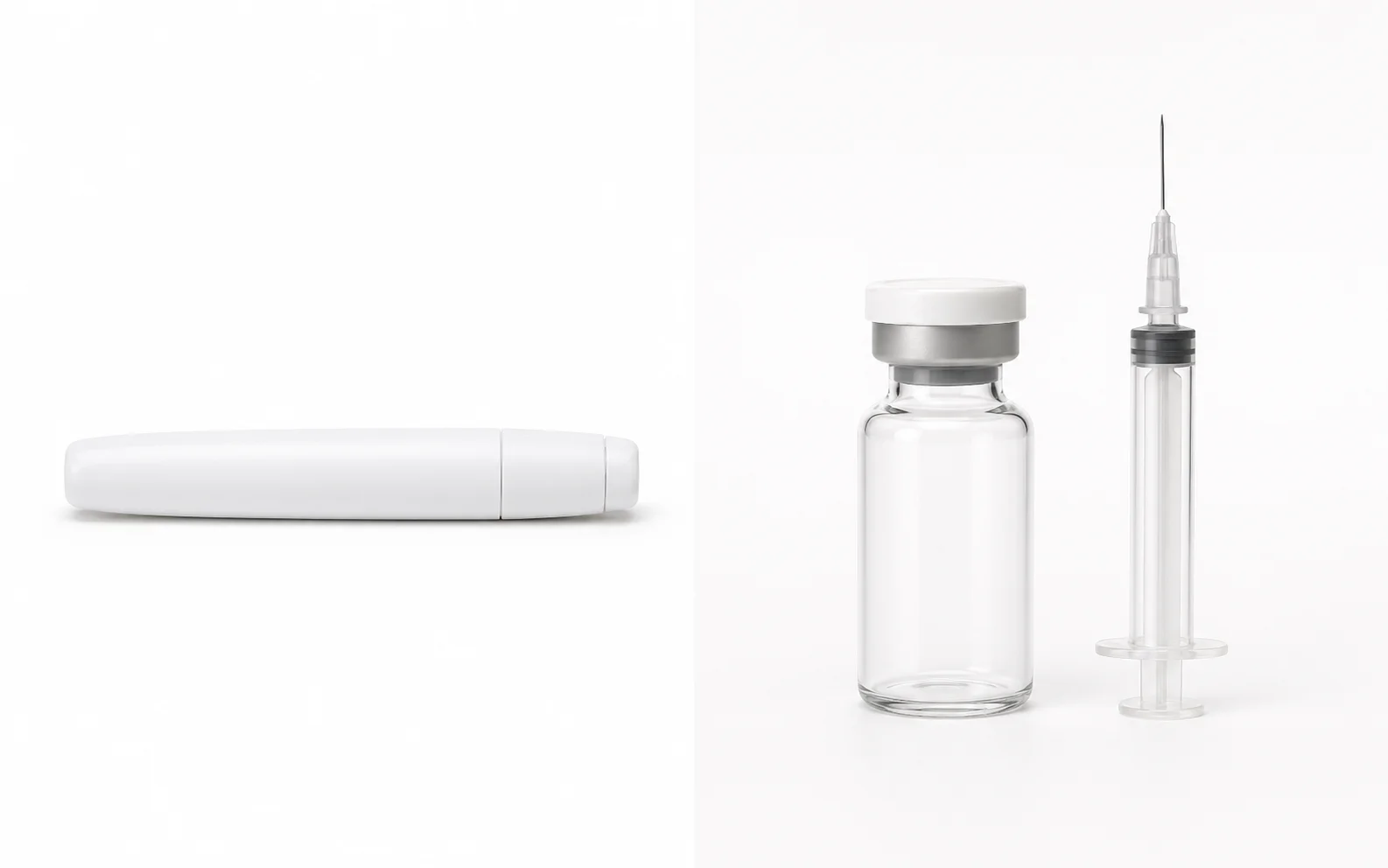
One of the most visible practical differences between brand and compounded GLP-1:
Brand-Name Delivery Formats
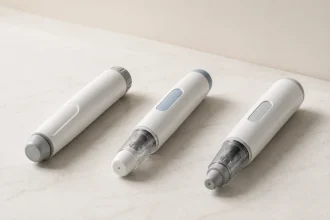
- Wegovy: Prefilled, single-use disposable injection pen — one pen per weekly dose
- Ozempic: Prefilled multi-dose pen (4 doses per pen at typical dosing)
- Mounjaro: Prefilled single-dose injection pen
- Zepbound: Available as single-dose vial or single-patient-use KwikPen (multi-dose)
- Rybelsus: Oral tablets
- Wegovy oral: Oral tablets
Compounded Delivery Formats
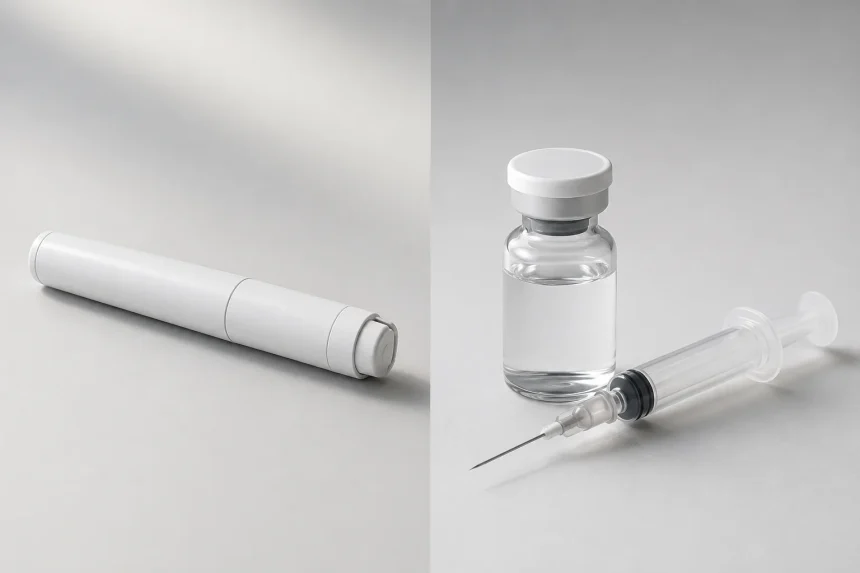
- Multi-dose vial with syringes: Most common format — patient draws their own dose with provided syringes
- Prefilled syringes: Some pharmacies offer pre-measured single-dose syringes as a convenience option
- Sublingual or oral drops: Some 503A pharmacies offer non-injection delivery formats
The practical differences:
- Convenience: Prefilled pens are easier to use — no measurement, no separate syringe, simpler injection mechanism. Vials require an additional step.
- Dosing flexibility: Vials allow custom doses (a 0.375mg intermediate between 0.25mg and 0.5mg, for instance). Brand pens are limited to manufacturer-set dose increments.
- Storage: Vials typically require refrigeration after opening (similar to brand-name in-use storage). Sterile single-use prefilled syringes have different stability profiles.
- Needle size: Brand pens come with built-in fine needles. Vial protocols use separate insulin-sized needles (typically 29-31 gauge, 4-6mm) — comparable injection experience.
- Travel and disposal: Pens are more travel-friendly. Vials require careful packaging and syringe disposal.
For most patients, the format difference is a moderate inconvenience rather than a barrier. The injection experience itself is comparable once you’ve practiced with the chosen format.
Insurance Coverage Reality
Insurance coverage is one of the starkest differences between brand and compounded GLP-1 — and a major driver of the cash-pay compounded market.
Brand-Name Insurance Coverage
- Type 2 diabetes formulations (Ozempic, Mounjaro, Trulicity, Victoza) are widely covered by commercial insurance and Medicare for diabetic patients. Prior authorization typical, but coverage is usually achievable with appropriate diagnosis.
- Weight management formulations (Wegovy, Zepbound, Saxenda) face significantly more variable coverage. Many commercial plans exclude weight loss medications entirely as “lifestyle drugs.” Some plans cover with BMI thresholds (≥30, or ≥27 with comorbidities) and step therapy requirements. Medicare standard Part D excludes weight loss coverage entirely.
- Manufacturer savings cards can dramatically reduce patient cost — Lilly Zepbound savings card brings cost as low as $25/month for covered patients, $499/month for patients with denied coverage.
- Medicare GLP-1 Bridge launching July 1, 2026 will cover Zepbound KwikPen at $50/month for qualifying Medicare beneficiaries with BMI ≥35 or BMI ≥27 with weight-related comorbidities.
Compounded GLP-1 Insurance Coverage
Insurance plans virtually never cover compounded GLP-1 medications. The reasoning: insurance formularies cover FDA-approved products with established indication, manufacturing standards, and pharmaceutical pricing structures. Compounded preparations don’t fit any of those categories.
- Commercial insurance: Coverage essentially never available for compounded GLP-1.
- HSA/FSA eligibility: Some Health Savings Accounts and Flexible Spending Accounts allow compounded medications as eligible expenses when prescribed for a documented medical condition. Verify with your specific benefits administrator.
- Medicare: Does not cover compounded medications under Part D.
This insurance gap is precisely what makes compounded GLP-1 economically necessary for many patients. Without coverage, cash-pay brand pricing ($1,000-$1,400/month) is prohibitive for most. Compounded preparations at $99-$297/month provide a financial path to treatment that brand-name pricing forecloses.
Clinical Effectiveness — What We Know and Don’t
The critical clinical question: when properly compounded with semaglutide base, does compounded semaglutide produce the same weight loss and metabolic effects as Wegovy?
What we know:
- The active molecule (semaglutide base) is chemically identical to FDA-approved semaglutide
- The mechanism of action — GLP-1 receptor activation in pancreatic beta cells, hypothalamic appetite centers, gastrointestinal tract — is identical because the molecule is identical
- STEP-1 trial demonstrated semaglutide 2.4 mg weekly produces -14.9% body weight reduction at 68 weeks
- Patient-reported outcomes from telehealth platform compounded semaglutide users (anecdotal but extensive) suggest comparable weight loss experiences
What we don’t know:
- No head-to-head randomized controlled trials have compared compounded semaglutide to brand-name Wegovy or Ozempic directly
- The variance in clinical outcomes across different compounding pharmacies has not been systematically studied
- Long-term outcomes (cardiovascular benefits demonstrated in SELECT trial, etc.) have only been established for brand-name semaglutide — extrapolation to compounded preparations is reasonable but not proven
The reasonable inference: when properly compounded by a legitimate 503A pharmacy using semaglutide base at equivalent doses, clinical effects should be comparable to brand-name semaglutide based on the identical active ingredient and mechanism. This is an inference based on pharmacology, not a proven equivalence based on direct clinical trials.
For tirzepatide, the same principles apply: SURMOUNT-1 NEJM data showed -15.0% (5mg), -19.5% (10mg), and -20.9% (15mg) body weight reduction at 72 weeks with brand-name tirzepatide. Properly compounded tirzepatide from tirzepatide base should produce similar outcomes — but again, no direct comparative trials exist.
Side Effect Profile
The side effect profile of properly compounded GLP-1 should mirror brand-name medications, since both produce their effects through the same molecular mechanism:
- Gastrointestinal (most common): Nausea, vomiting, diarrhea, constipation, abdominal pain — typically peaks during titration and improves with dose stability
- Appetite suppression: Reduced hunger, early satiety, reduced “food noise”
- Fatigue: Common during early weeks
- Injection site reactions: Minor and transient with proper technique
- “Ozempic face”: Facial volume loss from rapid weight reduction (cosmetic, not direct medication effect)
- Hair changes: Anecdotal reports of increased shedding, typically linked to rapid weight loss
- Rare serious effects: Pancreatitis, gallbladder issues, severe gastroparesis
Compounded-specific risks center on quality control issues rather than the active ingredient itself:
- Salt form substitution: If the pharmacy used semaglutide acetate or sodium instead of base, clinical effects may differ from brand-name (untested chemical entity)
- Contamination: Inadequate sterile compounding can introduce bacterial contamination — sterile compounding under USP <797> mitigates this risk
- Potency variance: Without standardized batch testing, potency may vary between pharmacies or between batches at the same pharmacy. COA documentation addresses this risk.
- Inactive ingredients: Compounded preparations may include different excipients (preservatives, stabilizers) than brand-name products — potentially relevant for patients with allergies to specific excipients
- Dosing errors: When patients draw their own doses from vials, measurement error is possible — over-dosing produces more severe side effects, under-dosing produces less efficacy
The thyroid C-cell tumor warning that appears as a black box on FDA-approved semaglutide and tirzepatide labels applies to all use of these molecules — whether brand-name or compounded. Do not use if you or your family have a history of medullary thyroid carcinoma (MTC) or Multiple Endocrine Neoplasia syndrome type 2 (MEN 2).
For comprehensive side effect management, see: GLP-1 Side Effects: Complete Survival Guide.
Legal Status in May 2026
The legal landscape for compounded GLP-1 has shifted substantially in 2024-2026. Current May 2026 status:
Compounded Semaglutide
- 503A patient-specific compounding: Remains available through licensed 503A pharmacies for individual patients with valid prescriptions. After the February 2025 shortage resolution, each prescription requires prescriber evaluation and documented clinical rationale rather than relying on shortage status alone.
- 503B outsourcing facility compounding: Restricted following the April 30, 2026 FDA proposed rule excluding semaglutide from the 503B Bulks List
- Shortage status: Resolved February 2025
For the complete regulatory picture, see our detailed guide: Compounded Semaglutide: The Complete 2026 Guide.
Compounded Tirzepatide
- 503A patient-specific compounding: Legal only through narrow medical necessity exceptions (documented polysorbate 80 allergy, non-standard dose or route, combination formulation with clinical significance)
- 503B outsourcing facility compounding: Effectively foreclosed — tirzepatide was never on 503B Bulks List, and enforcement discretion ended March 19, 2025
- Shortage status: Resolved December 19, 2024 by FDA declaratory order; never returned to shortage list
For tirzepatide-specific access analysis, see: Compounded Tirzepatide in 2026: What’s Legal, What’s Not.
“When FDA-approved drugs are available, outsourcing facilities cannot lawfully compound using bulk drug substances unless there is a clear clinical need. This action reflects our responsibility to protect patients and preserve the integrity of the drug approval process.”
Dr. Marty Makary, FDA Commissioner — April 30, 2026
How to Verify a Legitimate Compounded Source
If you decide that compounded GLP-1 is the right pathway for your situation, the most important decision becomes choosing a provider that operates legitimately. With 135+ FDA warning letters issued to compounders and telehealth platforms since September 2025, the variance in provider quality is real and meaningful.
Verification checklist for any compounded GLP-1 provider:
- Confirm 503A licensure. Ask explicitly: “What’s the name of the pharmacy compounding my prescription, and what state board licenses them?” Then verify that pharmacy on the state pharmacy board’s website. Legitimate 503A pharmacies are state-licensed and traceable.
- Verify medical evaluation occurs. A legitimate provider requires intake form review by a licensed prescriber before approving a prescription. Sites selling GLP-1 without medical evaluation are operating illegally.
- Check LegitScript certification. LegitScript is the telemedicine industry’s most recognized compliance authority. Certified providers display the LegitScript seal — verify at legitscript.com.
- Ask about PCAB accreditation. PCAB-accredited 503A pharmacies meet elevated standards beyond state minimums. Not all reputable pharmacies are PCAB-accredited, but the accreditation is a strong positive signal.
- Request information on USP standards. Compliance with USP <797> (sterile compounding) is the floor for legitimate injectable GLP-1 compounding. Reputable providers can confirm USP <797> compliance directly.
- Verify the active ingredient form. Confirm that semaglutide base (not acetate or sodium) is used. For tirzepatide, confirm tirzepatide base.
- Look for Certificate of Analysis availability. Reputable compounders provide batch-level COA documentation with potency, sterility, and endotoxin testing results.
- Demand transparent pricing. All-in monthly pricing should include medication, consultation, syringes/supplies, and shipping. Hidden fees indicate suboptimal transparency.
- Check shipping protocols. Compounded GLP-1 requires temperature-controlled shipping — insulated packaging with ice packs, expedited (1-2 day) carriers like FedEx or UPS.
- Verify state availability. Mississippi and Louisiana currently restrict telehealth prescribing of weight management medications. Most major telehealth providers cannot serve these states.
For a deeper dive on pharmacy verification, see: How to Verify a Legit Compounding Pharmacy.
💊 Looking for a Lower-Cost Compounded Option?
For cash-pay patients, compounded semaglutide is a lower-cost compounded option through a clinician-supervised telehealth model. Direct Meds offers Summer 2026 promotional pricing:
- Compounded Semaglutide: $147 first month ($150 OFF regular $297)
- Clinician-supervised dosing and titration support
- 503B compounding pharmacy network — patient-specific prescriptions
- LegitScript-certified telemedicine compliance
- USP <795> and USP <797> sterile compounding standards
- Available in 48 states (excludes MS and LA)
Compounded semaglutide contains semaglutide, but the compounded product itself is not an FDA-approved finished product and is not reviewed by the FDA for safety, effectiveness or quality. Whether it is appropriate for you is a decision for you and your clinician.
Who Should Choose Brand vs Compounded
The brand-vs-compounded decision depends on individual circumstances. Practical guidance for different patient profiles:
Choose Brand-Name When:
- Insurance coverage makes brand affordable. If your commercial insurance plan covers Wegovy or Zepbound and you can access savings card pricing ($25-$50/month), brand-name is the obvious choice.
- You have a type 2 diabetes diagnosis. Mounjaro or Ozempic through insurance is typically the most cost-effective and clinically established path.
- You need cardiovascular benefit indication. Brand-name Wegovy has FDA-approved indication for MACE reduction based on SELECT trial — compounded preparations don’t carry this indication.
- You need OSA indication. Brand-name Zepbound is the only FDA-approved pharmacotherapy for moderate-to-severe OSA in adults with obesity.
- You prefer prefilled pen convenience. The injection experience with prefilled pens is simpler than vial-and-syringe protocols.
- You’re enrolled or eligible for Medicare GLP-1 Bridge. July 2026 program provides Zepbound KwikPen at $50/month for qualifying Medicare beneficiaries.
- You’re concerned about quality variance. FDA-approved manufacturing provides more consistent quality assurance than 503A compounding, even from reputable pharmacies.
Consider Compounded When:
- Insurance doesn’t cover brand-name weight management. The most common scenario — commercial insurance covering Ozempic for diabetes but denying Wegovy for obesity. Compounded semaglutide bridges the affordability gap.
- You’re cash-pay with budget constraints. $147-$297/month compounded vs $1,349/month brand makes treatment economically accessible.
- You can verify your provider’s 503A compliance. Legitimacy verification is the prerequisite — choose accredited 503A pharmacies via LegitScript-certified telehealth platforms.
- You want dosing flexibility. Custom intermediate doses or microdose options are easier to obtain through compounding.
- You’re targeting moderate weight loss goals (10-15%). Compounded semaglutide at maximum dose produces similar outcomes to brand-name Wegovy.
Avoid Both When:
- You have contraindications. Personal or family history of MTC or MEN 2 syndrome — neither brand nor compounded is appropriate.
- You’re pregnant or planning pregnancy. Both brand and compounded GLP-1s are contraindicated.
- You have severe gastroparesis, active pancreatitis, or untreated gallbladder disease. Discuss alternative approaches with your prescriber.
- You can’t access legitimate sources. If your state restricts telehealth GLP-1 prescribing (Mississippi, Louisiana) and you don’t have an in-person prescriber, neither pathway is practically available.
Frequently Asked Questions
Is compounded semaglutide as effective as Wegovy?
When properly compounded using semaglutide base by a legitimate 503A pharmacy at equivalent doses, the active ingredient is chemically identical to Wegovy. Mechanism of action, weight loss outcomes, and side effect profile should be clinically equivalent. However, no head-to-head clinical trials directly compare compounded to brand-name semaglutide, so equivalence is inferred from identical pharmacology rather than proven by direct comparison.
Why is compounded so much cheaper than brand?
Brand-name pricing reflects costs that compounded preparations don’t carry: clinical trial expenses (often $1+ billion per drug development program), FDA new drug application costs, pharmaceutical-grade manufacturing at industrial scale, pharmacovigilance infrastructure, marketing expenditures, and substantial manufacturer margins. Compounding pharmacies prepare smaller batches using USP-grade active ingredients without those cost layers — the price difference reflects the manufacturing and regulatory pathway, not necessarily a difference in the molecule itself.
Can I switch from brand to compounded mid-treatment?
Yes, with a new prescription from a licensed provider. Most telehealth platforms accept patients transitioning from brand-name to compounded at the same dose to maintain treatment continuity. Inform your new prescriber of your current dose. Note that the delivery format changes — brand pens to vial-and-syringe — but the dosing schedule remains identical.
Is compounded GLP-1 covered by insurance?
Insurance virtually never covers compounded medications when an FDA-approved alternative exists. Some HSA and FSA accounts allow compounded GLP-1 as eligible expenses when prescribed for documented medical conditions — verify with your benefits administrator. The lack of insurance coverage is part of why compounded pricing remains competitive even after manufacturer cash-pay program improvements.
What’s the difference between semaglutide and semaglutide acetate?
Semaglutide base is the active ingredient in all FDA-approved semaglutide products. Semaglutide acetate is a salt formulation — a different chemical entity than semaglutide base. The FDA has stated salt forms have no lawful basis for use in compounding and have not been shown to be safe and effective. When evaluating compounded semaglutide providers, verify they use semaglutide base, not acetate or sodium salt forms.
Is brand-name safer than compounded?
FDA-approved brand-name manufacturing provides more standardized quality assurance — every batch undergoes validated testing, manufacturing facilities are FDA-inspected, and pharmacovigilance systems track adverse events at scale. Compounded preparations from PCAB-accredited 503A pharmacies operating under USP <797> produce preparations meeting professional pharmaceutical standards, but the framework is less comprehensive than FDA-approved manufacturing. The practical safety question depends substantially on which compounding pharmacy is involved — choosing a verified, accredited provider closes most of the gap.
Why hasn’t anyone done a head-to-head trial?
Head-to-head trials of compounded vs brand semaglutide would be challenging to fund and execute. Pharmaceutical manufacturers have little incentive to fund trials that might validate their cheaper competitors. Compounding pharmacies typically lack the resources to fund $50+ million clinical trials. Independent academic research might address the question over time, but no major studies are currently ongoing. Patients and providers operate on pharmacological inference: same molecule, same mechanism, expected same clinical effects.
Are compounded GLP-1 medications legal?
503A patient-specific compounding of semaglutide remains legal in May 2026, independent of shortage status. Compounded tirzepatide is legal only through narrow 503A medical necessity exceptions (polysorbate 80 allergy, non-standard dose/route, combination formulation with clinical significance). 503B outsourcing facility compounding is being curtailed by the April 30, 2026 FDA proposed rule. Always confirm your provider operates through a properly licensed 503A pharmacy.
Will the FDA approve generic semaglutide soon?
Novo Nordisk holds extensive patents on semaglutide that limit generic competition in the US until late this decade (specific dates depend on patent strategies and litigation outcomes). Similar patent timelines apply to Eli Lilly’s tirzepatide. Generic versions, once available, would offer FDA-approved pricing potentially competitive with current compounded pricing — but that timeline is years away. Compounded preparations are the current cash-pay alternative.
What about authorized generics or biosimilars?
Semaglutide and tirzepatide are peptide biologics — biosimilar pathways apply rather than traditional generics. The FDA’s biosimilar approval framework is being developed for GLP-1 medications, but no biosimilar GLP-1 has received FDA approval as of May 2026. When biosimilars eventually launch (likely late this decade), they may significantly reshape the pricing landscape.
The Bottom Line for May 2026
The brand-vs-compounded GLP-1 decision in 2026 is less about which option is “better” in the abstract and more about which option fits your specific circumstances of access, affordability, and goals.
For patients with insurance covering brand-name GLP-1 at affordable copays — particularly diabetic patients with broader coverage — brand-name medications offer the FDA-approved manufacturing standard, established cardiovascular and OSA indications, and prefilled pen convenience without the verification work required for compounded providers.
For patients without insurance coverage facing $1,000-$1,400/month brand cash-pay pricing, compounded semaglutide through a legitimate 503A pharmacy represents a meaningful financial path to treatment that wouldn’t otherwise be accessible. The same active molecule, dispensed under valid prescription with proper medical oversight, at 70-90% lower cost.
For compounded tirzepatide specifically, the May 2026 reality is that broad access has effectively ended — only narrow medical necessity exceptions remain for legitimate 503A compounding. Patients targeting tirzepatide’s higher-dose efficacy now realistically choose between brand-name Zepbound (LillyDirect Self Pay at $299-449/month) or transition to compounded semaglutide for moderate weight loss goals.
The crucial work for any patient considering compounded GLP-1 is provider verification: 503A licensure, LegitScript certification, USP <797> compliance, semaglutide base (not salts), PCAB accreditation when available, transparent pricing, and temperature-controlled shipping. These markers separate legitimate compounding from quality-risk operations.
Considering a Compounded Option?
For cash-pay patients pursuing semaglutide, Direct Meds offers compounded semaglutide through a clinician-supervised telehealth model, with Summer 2026 promotional pricing:
- $150 OFF first month compounded semaglutide injection ($147 vs regular $297)
- Licensed clinician reviews eligibility and oversees dosing and titration
- 503B compounding pharmacy network — patient-specific prescriptions
- LegitScript-certified telemedicine compliance
- USP <795> and USP <797> sterile compounding standards
- Telemed evaluation included (typically $99 value), 1-2 day FedEx/UPS shipping
- Available in 48 states (excludes MS and LA)
180,000+ patients have used Direct Meds; current Trustpilot rating 4.8. Compounded semaglutide contains semaglutide, but the compounded product itself is not an FDA-approved finished product and is not reviewed by the FDA for safety, effectiveness or quality. Whether it is appropriate for you is a decision for you and your clinician.
Affiliate disclosure: allcheminfo.com receives commission when readers start treatment through Direct Meds. Recommendation based on their 503B pharmacy partnership, LegitScript certification, and clinician-supervised model — not commission rate.