- The Injectable Dosing Charts
- Wegovy (semaglutide, weight management)
- Ozempic (semaglutide, type 2 diabetes)
- Mounjaro and Zepbound (tirzepatide)
- The Oral GLP-1s
- The Three Doses That Actually Matter
- How to Inject and Store It
- If You Miss a Dose
- When the Schedule Slips: Supply, Insurance and Real Life
- How to Tell You’ve Reached Your Dose
- Frequently Asked Questions
- Do I have to reach the maximum dose?
- What if a dose increase causes bad side effects?
- Can I change which day I inject?
- Is the starter dose supposed to do anything?
- If I switch from one GLP-1 to another, do I keep the same dose?
- The Bottom Line
Affiliate disclosure: This article contains affiliate links. We may earn commission when you purchase through partner links, at no extra cost to you. Editorial independence preserved — recommendations based on provider compliance and patient outcomes, not commission rates. This article is informational and is not medical advice; your dosing schedule is set by your prescriber.
This guide has the full 2026 GLP-1 dosing charts — Ozempic, Wegovy, Mounjaro, Zepbound and the oral options — starting right below. One idea to read them by: the number at the top of each ladder is a ceiling, not a goal, and most people’s working dose sits well below it. After the charts: how to use them — finding your dose, handling the weeks supply or insurance breaks the schedule, and knowing when to stop climbing.
The Injectable Dosing Charts
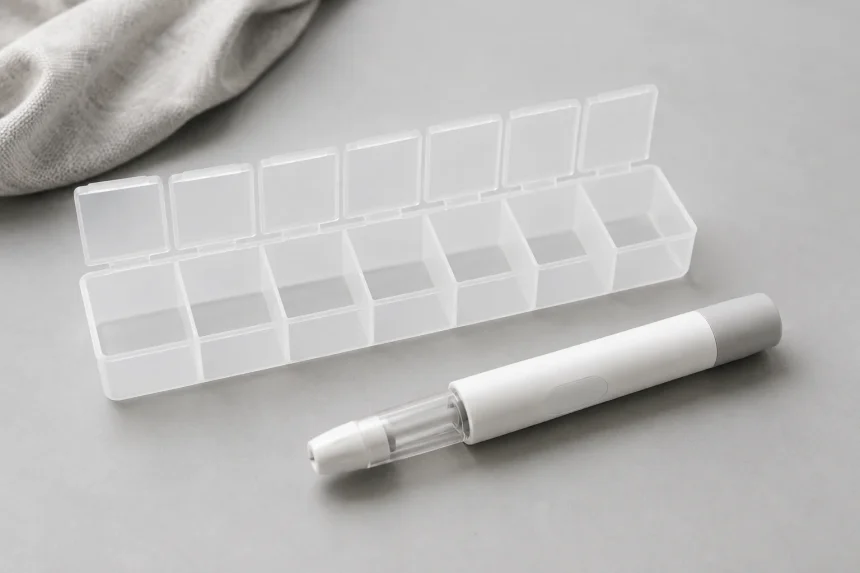
All four injectable GLP-1s are given once weekly, under the skin, on a roughly four-week step — and that four weeks is a minimum between increases, not a deadline. Semaglutide and tirzepatide each run a fixed ladder, but not the same way, and that difference is where most charts mislead.
Wegovy (semaglutide, weight management)
| Week | Wegovy dose (once weekly) |
|---|---|
| Weeks 1–4 | 0.25 mg — starter |
| Weeks 5–8 | 0.5 mg |
| Weeks 9–12 | 1 mg |
| Weeks 13–16 | 1.7 mg |
| Week 17 onward | 2.4 mg — standard maintenance |
Wegovy follows a genuinely fixed schedule, because the target dose is high and the climb has to be gradual to be tolerable. Two points beyond the ladder itself: 1.7 mg is not only a step on the way up — the label accepts it as a long-term maintenance dose for people who cannot tolerate 2.4 mg. And Wegovy HD, the 7.2 mg dose, is a separate higher tier, reached only after at least four weeks at 2.4 mg — not a routine next step.
Ozempic (semaglutide, type 2 diabetes)
| Dose (once weekly) | Role |
|---|---|
| 0.25 mg | Starter — first 4 weeks only; not a treatment dose |
| 0.5 mg | First maintenance dose, reached after the 4-week start |
| 1 mg | Optional step up — after at least 4 weeks at 0.5 mg, if blood sugar control needs it |
| 2 mg | Maximum — optional step up after at least 4 weeks at 1 mg |
Ozempic shares semaglutide’s early steps but, unlike Wegovy, has no fixed endpoint. The 0.25 mg starter runs four weeks, then 0.5 mg becomes the first real treatment dose — and for many people, the one they stay on. Moving to 1 mg, then 2 mg, happens only if blood sugar is not yet at goal, with at least four weeks at each level. Your maintenance dose is simply whichever of 0.5, 1 or 2 mg controls your diabetes; reaching 2 mg is common but not an expectation.
Mounjaro and Zepbound (tirzepatide)
| Phase | Dose (once weekly) — Mounjaro and Zepbound |
|---|---|
| Weeks 1–4 — starter | 2.5 mg |
| Weeks 5–8 | 5 mg |
| Then, every 4 or more weeks if needed | 7.5 mg → 10 mg → 12.5 mg → 15 mg |
| Maximum | 15 mg |
Mounjaro and Zepbound run on one ladder because they are one drug — tirzepatide. After the 2.5 mg starter and the 5 mg step, the dose can rise in 2.5 mg increments to a maximum of 15 mg, four weeks minimum at each level. The maintenance range is broad — 5, 10 and 15 mg are all recognized maintenance doses, and many people do well without ever reaching 15 mg.
One thing the charts assume but rarely state: a branded pen delivers the dose it is built for, and only that. The disposable pens are single-dose; the dial-style and KwikPen devices are calibrated to set strengths. They are not made to be split, stretched across two weeks, or coaxed into a half-dose — trying risks an inaccurate dose. If a charted dose is not working for you, the answer is a different pen strength from your clinician, not an improvised one. Compounded semaglutide is the exception in form: drawn from a vial to whatever dose the prescriber sets, which is why compounded dosing is individual rather than fixed.
The Oral GLP-1s
Not every GLP-1 is an injection. Four oral options now exist, and they titrate too — same start-low principle, different form.
| Oral medication | Drug and use | Dose steps (once daily) |
|---|---|---|
| Rybelsus | Oral semaglutide — type 2 diabetes | 3 mg → 7 mg → 14 mg |
| Wegovy oral tablet | Oral semaglutide — weight management | 1.5 mg → 4 mg → 9 mg → 25 mg |
| Ozempic tablets | Oral semaglutide — type 2 diabetes | 1.5 mg → 4 mg → 9 mg |
| Foundayo | Orforglipron — weight management | 0.8 mg → 2.5 mg → 5.5 mg → 9 mg → 14.5 mg → 17.2 mg |
One practical point separates these. The oral semaglutide products — Rybelsus, the Wegovy tablet and Ozempic tablets — must be taken first thing on an empty stomach, with no more than a small sip of plain water, then a 30-minute wait before any food, drink or other medication. That timing is not fussiness; it is what lets the drug absorb at all. Foundayo, which uses a different drug — orforglipron — carries none of those restrictions: any time of day, with or without food, any amount of water. That flexibility is much of its appeal.
The Three Doses That Actually Matter
You have just seen six or seven strengths across these charts. In practice only three matter to any one person.
The first is your starting dose — 0.25 mg for semaglutide, 2.5 mg for tirzepatide. It is deliberately too low to do much: not a treatment dose, never meant to be, there only to introduce the drug gently and blunt early side effects. If your first month brings little change in weight or blood sugar, that is the starting dose working as designed.
The second is the maximum dose — 2 mg for Ozempic, 2.4 mg (or the 7.2 mg HD tier) for Wegovy, 15 mg for tirzepatide. This is a ceiling, not a destination. It exists for the people who need it, and plenty of people never do.
The third — the one that matters — is your effective dose: the lowest dose that gives you the result you want with side effects you can live with. It sits between the other two, and for most people lands below the maximum. The titration ladder is not a staircase you must climb to the top; it is the search for that middle number. You are not trying to reach the end of the chart — you are trying to find your place on it.
How to Inject and Store It
Injectable GLP-1s go in subcutaneously — into the fat just under the skin, not into muscle — and the modern pens make this straightforward. Before starting, have a clinician or pharmacist walk you through your specific device; what follows is the shape of it.
Inject into the abdomen (a little away from the navel), the front of the thigh, or the back of the upper arm — and rotate the site each week rather than reusing one spot, which protects the skin and the fat beneath it. The shot goes in once weekly, same day each week, any time of day, with or without food. Check the medication first: it should be clear and colorless to slightly yellow, and a cloudy pen or one with particles should not be used. Use a fresh needle each time if your pen takes removable needles, and never share a pen, even with a new needle. You can change your injection day if you need to — for travel, say — as long as doses stay at least 48 hours apart for semaglutide and 72 hours apart for tirzepatide.
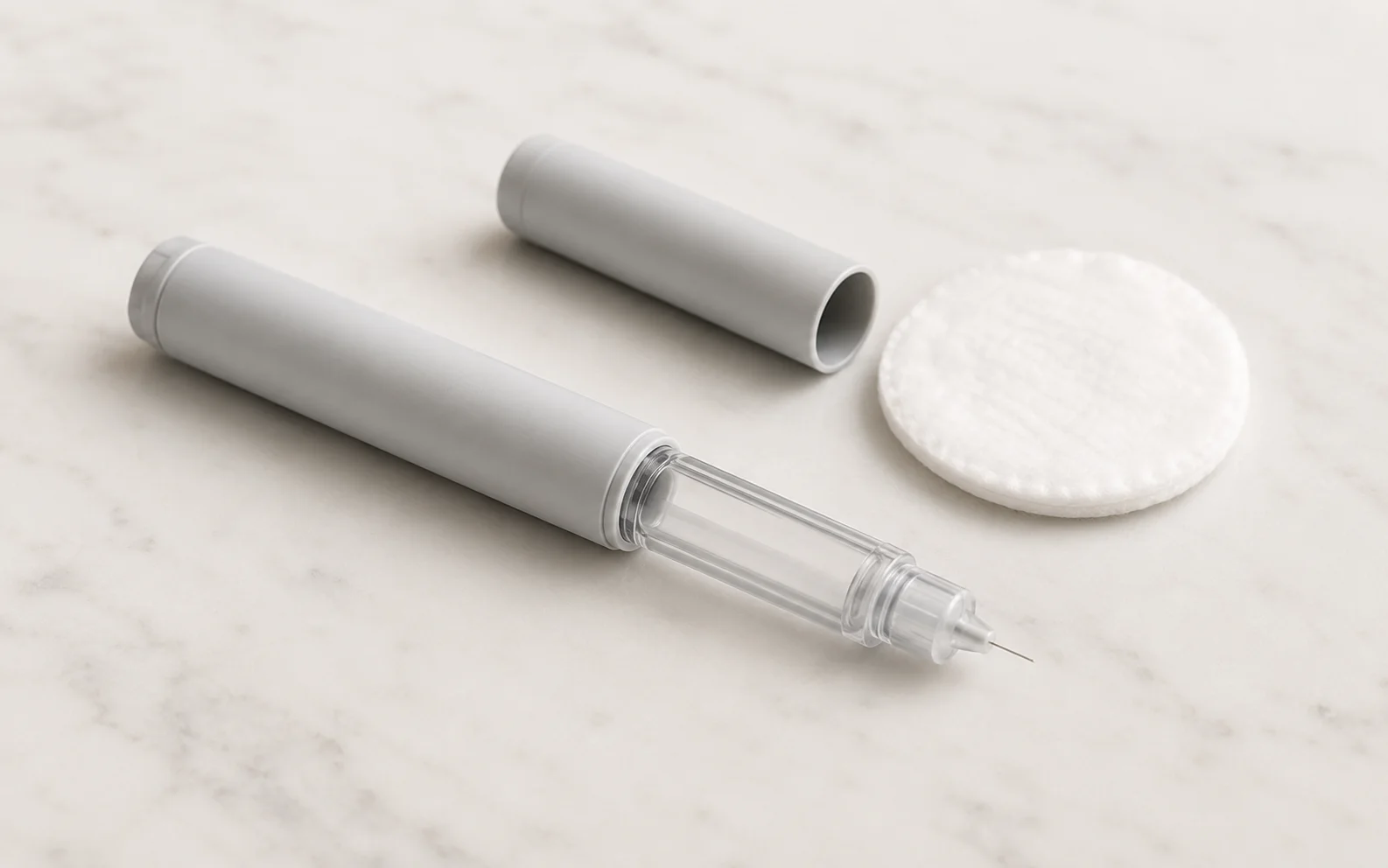
Storage is simple but worth getting right. Unopened pens live in the refrigerator, never the freezer — discard any pen that has frozen. Most also tolerate a stretch at room temperature, which matters for travel, though the allowance differs by product: an Ozempic pen in use keeps for several weeks at room temperature or refrigerated, and the tirzepatide single-dose pens last up to about three weeks unrefrigerated. Wegovy pens have their own room-temperature window — check your pen’s instructions. Keep all of them out of direct light and away from children, and never use a pen past its expiry. Oral tablets are easier still: room temperature, in their original packaging.
If You Miss a Dose
Missed-dose rules genuinely differ drug to drug — one of the few places where guessing can go wrong. Here is what each label says.
| Medication | If you miss a dose |
|---|---|
| Ozempic | Take it within 5 days of the missed dose. If more than 5 days have passed, skip it and take your next dose on the regular day. |
| Wegovy and Wegovy HD | If your next scheduled dose is more than 2 days (48 hours) away, take the missed dose now. If it is less than 2 days away, skip it and resume on the regular day. |
| Mounjaro and Zepbound | Take it within 4 days (96 hours) of the missed dose. If more than 4 days have passed, skip it. Never take two doses within 3 days of each other. |
| Oral semaglutide (Rybelsus, Wegovy & Ozempic tablets) | Skip the missed dose entirely. Take the next dose at the usual time the following day — do not double up. |
| Foundayo (orforglipron) | Take the missed dose as soon as you remember that day. Do not take two doses in one day. If you miss 7 or more days in a row, contact your prescriber about restarting. |
One missed weekly dose is minor — appetite may tick up a little, but a single gap does not undo your progress. Two or more in a row is a different situation — and the next section is about exactly that.
When the Schedule Slips: Supply, Insurance and Real Life
In a clinical trial the titration schedule is clean. In real life it is not — and what most often knocks people off the ladder is not their body, it is the supply chain. A pharmacy is out of your next strength; insurance changes between fills; a compounded source pauses. These gaps are common, and how you handle one matters more than the gap itself.
Two rules cover most situations. First, never try to “catch up”: do not jump two steps to make up lost ground, and never take two doses close together for a missed one — a sudden jump brings exactly the side effects the slow ladder exists to prevent. Second, treat a real gap as a restart. A single missed week is minor, but if a stockout or coverage lapse has kept you off the drug, or well below your dose, for several weeks, your tolerance fades — and resuming at your old dose can bring back nausea you had long since left behind. After a gap like that, the safe path is to step down and re-titrate under your prescriber’s guidance.
Re-titrating feels like lost progress. It is not — it is the difference between restarting smoothly and restarting miserably, and the lost weeks come back fast. What genuinely helps is foresight: if you can see a gap coming — a trip, a known supply problem, a planned pause around surgery — flag it to your prescriber in advance, so the restart is planned rather than improvised.
💊 Looking for a Lower-Cost Compounded Option?
For cash-pay patients, compounded semaglutide is a lower-cost compounded option through a clinician-supervised telehealth model. Direct Meds offers Summer 2026 promotional pricing:
- Compounded Semaglutide: $147 first month ($150 OFF regular $297)
- Clinician-supervised dosing and titration support
- 503B compounding pharmacy network — patient-specific prescriptions
- LegitScript-certified telemedicine compliance
- USP <795> and USP <797> sterile compounding standards
- Available in 48 states (excludes MS and LA)
Compounded semaglutide contains semaglutide, but the compounded product itself is not an FDA-approved finished product and is not reviewed by the FDA for safety, effectiveness or quality. Whether it is appropriate for you is a decision for you and your clinician.
How to Tell You’ve Reached Your Dose
The hardest question in GLP-1 dosing is not how to climb the ladder — it is knowing when to stop climbing. There is no line on the chart for it, because the answer is a result, not a milligram.
You have reached your effective dose when two things are true at once: you are getting the outcome you came for, and tolerating the dose well enough to stay on it long term. What “the outcome” means depends on why you are taking the drug. For weight, it is steady, gradual loss at a rate you and your clinician are comfortable with, plus appetite that genuinely feels under control — not loss at any cost, and not loss so rapid it becomes its own concern. For type 2 diabetes, it is blood sugar and HbA1c reaching the targets your clinician set. Hit that result and feel well on the dose, and you have arrived — climbing further mostly trades extra side effects for diminishing returns.
This is why holding a dose, or stepping back down after a bad step, is a normal part of the process, not a failure. The four-week interval is a minimum you can stretch; if side effects from the last increase have not settled, holding longer is the standard move. Stopping altogether is a separate decision, one to make with a prescriber, because it carries a predictable consequence — for most people, appetite and weight return after withdrawal. That does not make stopping wrong; it makes it a planned transition rather than something to improvise in a hard week.
Frequently Asked Questions
Do I have to reach the maximum dose?
No. The maximum approved dose is a ceiling, not a goal. Many people get strong results on a mid-ladder dose — 1 mg of Ozempic, 1.7 mg of Wegovy, 10 mg of tirzepatide — and good reason to stay there. Your effective dose is the lowest one that delivers your result with tolerable side effects, and for most people that lands below the maximum.
What if a dose increase causes bad side effects?
Slow down, do not push through. A clinician will often have you hold at the dose you tolerate for an extra few weeks, or step back down a level before advancing again. The four-week interval is a minimum between steps, not a deadline — a slower climb you can tolerate beats a fast one that drives you off the medication.
Can I change which day I inject?
Yes, if needed — around travel, for example. Keep enough time between doses: at least 48 hours apart for semaglutide (Ozempic, Wegovy) and at least 72 hours apart for tirzepatide (Mounjaro, Zepbound). Once shifted, settle onto the new day as your regular weekly slot.
Is the starter dose supposed to do anything?
Not much, and that is by design. The 0.25 mg semaglutide and 2.5 mg tirzepatide starter doses exist only to introduce the drug and limit early side effects. They are not treatment doses, so little change in the first few weeks is expected — the meaningful effect comes as you climb into the maintenance range.
If I switch from one GLP-1 to another, do I keep the same dose?
Generally no. There is no clean dose equivalence between these drugs — semaglutide and tirzepatide are different molecules, and the milligram numbers do not translate across them. A switch usually means restarting at a low dose of the new medication and titrating up again rather than matching your old dose, which also limits the side effects a sudden jump would cause. The crossover is set by your prescriber.
The Bottom Line
Keep the charts — every GLP-1 starts low and climbs on a roughly four-week step, semaglutide and tirzepatide each run their own ladder, and the missed-dose rules differ enough to be worth checking against the right drug. But the chart is the map, not the destination. Three doses matter: a starting dose built to do little, a maximum dose that is a ceiling rather than a target, and — the one that counts — your effective dose, the lowest one that delivers your result on terms you can live with. Climb at the pace your body sets, expect supply and insurance to interrupt the schedule, restart carefully when they do, and stop climbing once the dose is working. For managing the side effects that come with each step, see our guide to GLP-1 GI side effects; for how the drugs compare, our 2026 brand comparison.
Considering a Compounded Option?
For cash-pay patients pursuing semaglutide, Direct Meds offers compounded semaglutide through a clinician-supervised telehealth model, with Summer 2026 promotional pricing:
- $150 OFF first month compounded semaglutide injection ($147 vs regular $297)
- Licensed clinician reviews eligibility and oversees dosing and titration
- 503B compounding pharmacy network — patient-specific prescriptions
- LegitScript-certified telemedicine compliance
- USP <795> and USP <797> sterile compounding standards
- Telemed evaluation included (typically $99 value), 1-2 day FedEx/UPS shipping
- Available in 48 states (excludes MS and LA)
180,000+ patients have used Direct Meds; current Trustpilot rating 4.8. Compounded semaglutide contains semaglutide, but the compounded product itself is not an FDA-approved finished product and is not reviewed by the FDA for safety, effectiveness or quality. Whether it is appropriate for you is a decision for you and your clinician.
Affiliate disclosure: allcheminfo.com receives commission when readers start treatment through Direct Meds. Recommendation based on their 503B pharmacy partnership, LegitScript certification, and clinician-supervised model — not commission rate.
Dosing details in this article reflect the FDA prescribing information for each medication as of May 2026 and can change. They are a general reference, not a substitute for individual medical advice — your dosing schedule is set by your prescriber.